Buffalo Bill’s “Americanata” between European success and modenese skepticism: chromolithographic art and female emancipation…

Buffalo Bill’s “Americanata” between European success and modenese skepticism: chromolithographic art and female emancipation.
By the early twentieth century, the myth of the American Wild West was no longer just a distant echo recounted in adventure novels. It was a tangible, noisy, and colourful reality that moved on rails. Colonel William Frederick Cody, universally known as “Buffalo Bill,” succeeded in transforming the American frontier into an unprecedented traveling spectacle: the Wild West Show.
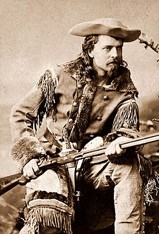
With hundreds of horses and bison, an impressive troupe of cowboys, skilled markswomen, horsewomen and Native Americans, Cody crossed the Atlantic to show the epic story of the New World to the Old Continent. However, his European tour did not resonate equally everywhere: while his visit to London and Paris was greeted with enthusiasm and royal honours, his encounter with Italy, and in particular with the pragmatism of the Emilian province, revealed a more complex reaction, tinged with wonder but also with biting scepticism.
Before arriving on the peninsula, Cody’s theatrical spectacle had already enshrined its creator as a living legend in the major European capitals. The turning point came in 1887 in London, during the American Exhibition organised to mark Queen Victoria’s Golden Jubilee.
An exclusive performance was arranged for the British monarch, who had long since retired to private life. The event made such an impression on her that, as the American flag passed by, she rose to her feet, signifying a symbolic reconciliation with the former colony.
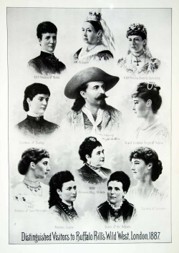
Even the future Edward VII became an avid fan of the show. On 11 May at Earls Court, the Prince of Wales arranged a special performance for his royal guests. He climbed aboard the famous ‘Deadwood Stagecoach’, sitting on the box seat alongside Buffalo Bill, to experience the thrill of a ride around the arena under a simulated attack by Sioux and Cheyenne warriors, amidst blank gunfire and war cries. Inside the vehicle were the kings of Belgium, Greece and Saxony, and the Crown Prince of Denmark, who were in London for the celebrations.
Two years later, in 1889, it was Paris’s turn. Encamped at the foot of the newly erected Eiffel Tower during the Universal Exhibition, the show spellbound the Belle Époque. Parisian high society, intellectuals and artists – such as Paul Gauguin, who visited Buffalo Bill’s camp on several occasions, fascinated by the ‘myth of the noble savage’ – were captivated by the roaring aesthetics of the West.
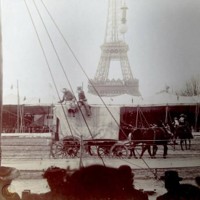
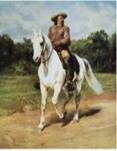
The French capital turned Cody into a style icon and the Wild West into a mass phenomenon, so much so that it prompted the famous painter Rosa Bonheur to paint from life, right there in the camp, the Colonel on horseback and the proud Sioux warriors.
Italy first experienced the Wild West Show in 1890, and a second, more widespread, one in 1906.
The first tour was marked by extraordinary events. On March 3, 1890, Buffalo Bill and his troupe were received at the Vatican by Pope Leo XIII, in an audience that had an enormous resonance even in the American press
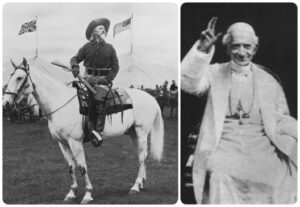
A few days later, on 8 March in Rome, in the Prati di Castello area, the most famous episode took place. Duke Onorato Caetani di Sermoneta sought to challenge the cowboys’ reputation by claiming that the ‘butteri’ – the traditional Italian cowboys- were superior at taming wild horses.
Thus began a legendary contest between the Americans and a team of ‘butteri’ led by Augusto Imperiali, known as ‘Augustarello’. Before the eyes of a frenzied crowd, the ‘butteri’ skilfully tamed the ferocious American mustangs. Tradition has it that Imperiali won the bet, but Cody, resentful of the defeat, packed up and left without paying the full agreed prize. The episode elevated the ‘butteri’ to the status of national heroes, demonstrating that Italy was ready to take on the challenge posed by the American imagination.
In 1906, the Show returned with an even more impressive production. Turin gave it the warmest reception, with endless queues at the box offices and a lasting impact on popular culture.
The people of Turin were so captivated by the myth of the Western hero that several folk songs sprang up; the most famous, composed by the impoverished Count Eugenio Piossasco – known as Eugenio Veritas – told the story of poor Tonin, abandoned by his Rosina, who had run off with a young man from Buffalo Bill’s troupe. The impact on popular culture was immediate, to the point that even children began playing ‘cowboys and Indians’.
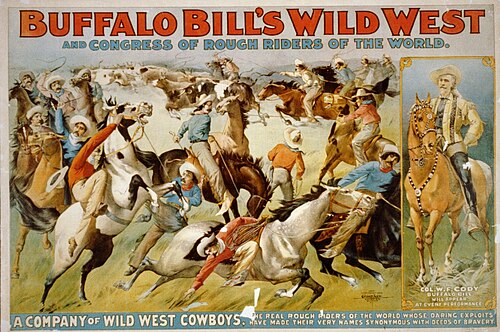
The arrival of the Wild West Show in Modena, as elsewhere in Italy, was preceded by an advertising strategy that, for its time, represented a groundbreaking visual innovation: American chromolithography.
This colour printing technique on limestone allowed for vibrant, saturated, and weather-resistant images. To produce a single poster, up to ten or twelve different stones were needed, one for each colour, layered with pinpoint precision. More than just advertising, chromolithography was considered a new form of commercial graphic art, capable of bringing beauty and figurative mastery directly to the streets.
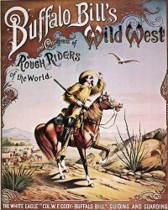
From an artistic point of view, the strength of this technique lay in its ability to blend the realism of classical painting with the concise and dynamic impact of modern poster art. Through the skilful application of pigments and a dramatic use of chiaroscuro, the images did not merely illustrate, but brought the myth to life: the sharp contours of the faces, the vigour of the horses’ muscular forms and the brilliance of the reds, blues and golds transformed the paper surface into a living canvas, endowed with a three-dimensionality entirely unknown to European letterpress printing of the time
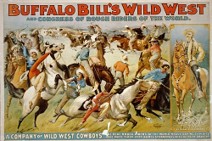
Cody had millions of these enormous artistic posters printed directly in the United States, relying on renowned printing firms such as the Strobridge Lithographing Co. of Cincinnati. The posters were packed into wooden crates, shipped across the Atlantic on steamships and then loaded onto the ‘advertising railcars’ that followed the show’s trains.
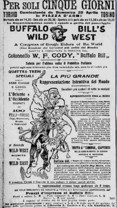
Teams of American ‘poster-hangers’ – Cody’s famous Bill Posting Crews – would arrive several days ahead of the show and, travelling along the railway network, plastered walls and stations throughout the province. A large poster was put up at Mirandola station, which was then the terminus of the local line to Modena. Unfortunately, the vintage black-and-white photograph does not do justice to the colours of the original chromolithograph, and the large lettering obscures the illustration, of which only a few faint outlines can be made out.
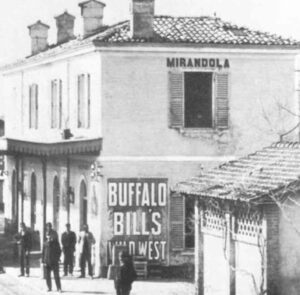
At a time when the urban and suburban landscape was dominated by grey bricks and black-and-white prints, the visual impact on the public was a real cultural shock. People would stop, spellbound, in front of those posters on the walls or displayed in shop windows, which transformed streets, squares and even Mirandola railway station into a wide-open window onto an exotic and unattainable world.
The strategic aim of this poster campaign was crystal clear: to attract people from the Bassa Modenese (Modenese lowlands) to the Modena leg of the tour on April 6, 1906, making use of the local railway line which allowed hundreds of spectators to reach the provincial capital with ease.
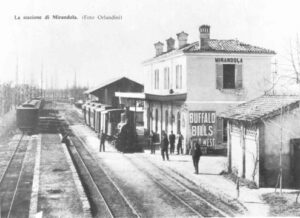
Mirandola station in a period photograph
While the turnout was impressive, with 950 people setting off from Mirandola and Finale Emilia alone, the reaction of the local press was very different from the royal enthusiasm of London or the popular fervour in Turin. Newspapers such as La Provincia di Modena, Il Panaro and Gazzetta di Modena analysed the show with a critical and pragmatic eye, far removed from easy enthusiasm.
In the weeks leading up to the big event, faced with the barrage of colourful posters, La Provincia di Modena remarked ironically: “His fame is now established. Buffalo Bill doesn’t have enough arms to count all the money. So he must be right.”
Following the performance at Piazza d’Armi, now the Novi Sad area, journalists from Modena did not hold back in their harsh criticism of the show’s content, branding it a well-orchestrated commercial venture, but one lacking in artistic depth. Il Panaro, for instance, declared it “a true Americanata, brilliant, entertaining, and with the added merit of lasting only two hours, yet which in substance fails to live up to the enormous expectations aroused by its phenomenal publicity”.
La Provincia di Modena also highlighted the mediocrity of the acts, stating that “the performers are not on a par with those seen in dozens of equestrian circuses incomparably richer, more interesting and more varied than this one”, as they presented “utterly commonplace routines, with costumes that were less than mediocre”.
Another source of controversy was the financial aspect: ticket prices, ranging from 1.20 lire for general admission seats (equivalent to a farm labourer’s daily wage) to 8 lire for boxes, were deemed excessive. The press accused Cody of having come to Emilia with the sole aim of ‘raking in money by the bucketful’, exploiting the public’s gullibility.
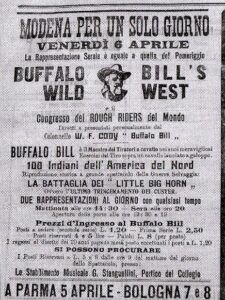
From a logistical point of view, however, even the harshest critics from Modena were forced to praise the efficiency of the American organisational machine: the show was, in fact, transported on four special trains carrying 800 people and over 500 horses.
Il Panaro described the setting up of the camp with admiration: “Everything has been planned in advance. Everyone is told what they must do, knows it, and complies with the instructions received. In less than two hours, the equipment needed to pitch the tents is transported to the site.”
For the spectators, the real attraction was not just the chase between Indians and cowboys, but the sight of a perfectly self-sufficient travelling town, equipped with field kitchens, workshops, stables and even a portable electric generator for the evening floodlights.
Among the crowd, which had travelled from as far afield as the Bassa Modenese, there was great anticipation surrounding a legendary name: Calamity Jane, born Martha Jane Cannary. In the collective imagination of the time, fuelled by adventure magazines and folk tales, the figure of the famous frontier heroine was inseparable from that of Buffalo Bill, so much so that many spectators travelled to Modena in the hope of seeing her ride in person.
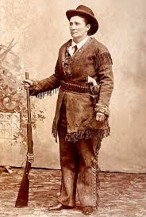
The historical reality, however, was quite different. Calamity Jane had indeed joined the Wild West Show in the United States for a short period in 1902. However, her struggles with alcoholism and her intolerance of Cody’s strict discipline led to a swift break-up. Martha Jane died tragically in 1903, three years before the second European tour.
Despite her absence, the audience almost believed they recognised her in the many skilled markswomen and horsewomen who filled the arena. For the audience of the time, any American woman capable of taming a horse or shooting while riding represented the embodiment of Calamity Jane.
There is a fundamental aspect of the Wild West Show, often overlooked in contemporary accounts, that constitutes the most revolutionary legacy left by Buffalo Bill during his visit to Italy: the portrayal of female emancipation.
In the Emilia countryside of 1906, women were predominantly confined to domestic roles and hard labour in the fields. Even for women of the upper middle class, the scope for freedom was limited: bound as they were to preserve the decorum imposed by social conventions, when they rode, they were permitted to do so exclusively side-saddle, that is, sitting sideways.
Suddenly, on the Piazza d’Armi parade ground in Modena, exceptional performers appeared such as Minnie Thomson, Luella Forepaugh-Fish and the Lady Rough Riders, who were not mere extras, but a central and formidable part of the show.
Minnie Thomson was one of the most acclaimed regular performers on the great European tour of 1906. A trick rider and expert markswoman, she performed high-speed carousels, executing manoeuvres previously reserved for cowboys, mounting and dismounting while the horse was at a full gallop.
Luella Forepaugh-Fish came from a famous family of American circus impresarios. A horse tamer and rodeo rider, she entered the arena with the wild horses of the West to show how a woman could bend them to her will. Alongside her displays of strength in the arena, she performed lasso skill acts, demonstrating a proficiency that astounded audiences not only in Italy.
Cody also brought to Modena an entire team of American female riders, presented in the official programs as the Lady Rough Riders. They fired light rifles and pistols, hitting glass spheres or targets thrown into the air by their male colleagues, all the while remaining firmly in the saddle. They also took part in the grand group reenactments, such as the stagecoach attack, alongside the men and with the exact same grit.
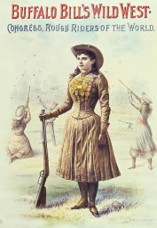
These women, who rode astride in trousers or short leather skirts, handled the lasso, tamed stallions and shot with a precision that was at times superior to that of men, displayed a physical ease, courage and fortitude never before seen on the Italian stage.
At a time when women’s presence in public spaces was strictly regulated, the Wild West Show’s arena shattered every patriarchal stereotype. The American performers did not merely offer a display of strength and dexterity, but they embodied a tangible form of emancipation: economically independent women whose technical mastery redefined the very concept of femininity.
For the women who had travelled by train from the Bassa Modenese, the show offered a completely new vision of female autonomy, skill and dignity.
This message of emancipation was neither accidental nor purely theatrical, but stemmed from a firm ethical conviction held by William Cody, who was one of the earliest and most radical advocates of women’s rights in America at the time.
In his show, the female performers were not merely decorative extras, but main attractions. Cody applied a rule that, at the start of the 20th century, seemed almost utopian: equal pay for equal work. In an interview with the press, the colonel stated firmly: “If a woman can do the same job as a man and does it well, she deserves exactly the same pay”.
While local newspapers focused on the controversies surrounding ‘the American money-making machine’, it escaped the reporters’ notice that Buffalo Bill’s Show was, in fact, bringing to Giolitti’s Italy one of the first and most powerful models of gender equality and women’s independence.
Buffalo Bill’s tour, with its stop in Modena and the profound impact it had in the Mirandola area, was not merely a fleeting entertainment event. It represented a genuine cultural clash between two worlds: a dynamic, capitalist, forward-looking America, and an Emilia rooted in its traditions, capable of marvelling, but also of analysing reality with pragmatism.
That poster, displayed at the Mirandola station in 1906, bore witness to the precise moment when the province of Emilia encountered the myth of the Frontier. While local newspapers tended to dismiss the Wild West Show as an “Americanata” (American kitsch), the hundreds of people who packed the trains from Mirandola to Modena took home the indelible memory of a unique spectacle: an exotic mix of Native Americans and bison, a flawlessly organised logistical operation and, above all, the first glimmer of women’s freedom that would shape the decades to come.
Translated by the author
Bibliography
- Bussoni, Mario, Buffalo Bill in Italia. L’epopea del Wild West Show, Fidenza, Ed. Mattioli 1885, 2011;
- Casini, Fabio-Montella, Fabio, Quando la Bassa Viaggiava in Tram, Finale Emilia, CDL, 2012;
- Detti, Ermanno, Calamity Jane. Il mito e la realtà, Milano, Mimesis, 2021;
- Donna, Sergio, Amarcord del Novecento: le avventure torinesi di Buffalo Bill, in storiepiementesi.it;
- Marinucci, Alessandro, C’era una volta Augusto Imperiali, in storiachepassione.it;
- Moses, L.G., Wild West Show and the Images of American Indians, 1883-1933, University of New Mexico Press, 1996;
- Scharff, Virginia, Twenty-Thousand Roads: Women, Movement, and the West, University of California Press, 2003;
- Vellucci, Luigi, I butteri, Buffalo Bill, il West, Ed. Pugliesi, 2009
- La Provincia di Modena, issues of March 25-26, April 3-4 and April 7, 1906;
- Il Panaro, issues of April 6-7, 1906;
- Gazzetta di Modena, issues of April 6-8, 1906.
Born in Mirandola, she holds multiple Master’s Degrees from the Alma Mater Studiorum, University of Bologna, having developed a distinguished multidisciplinary profile in philosophy, literature, history and the arts. She founded her own Studio Didattico, a private teaching school, where she taught for over twenty years as a private tutor and learning coordinator. Alongside this activity, she spent fifteen years teaching humanities in public secondary schools in the province of Modena. Over the years, she has also supplemented her studies with specialisation courses at prestigious Italian foundations.
A former editor of art texts and author of handbooks on various specialised topics, she has conducted seminars and lecturers also abroad in Italian art.
She maintains ongoing professional collaborations in various capacities with university professors in Italy and abroad.
She is an independent researcher, writer and ghostwriter.
Her collaboration with Al Barnardon is driven by the conviction that local culture in all its facets, from art to history, literature to philosophy, and traditions, represents an invaluable heritage to be supported and enhanced.