Roberta Paltrinieri – Perle di cultura – Emilian forniture: from the furnishings of the Po Valley court to the craftsmanship of the “Bassa Modenese“ (Modena lowlands)

Born in Mirandola, she holds multiple Master’s Degrees from the Alma Mater Studiorum, University of Bologna, having developed a distinguished multidisciplinary profile in philosophy, literature, history and the arts. She founded her own Studio Didattico, a private teaching school, where she taught for over twenty years as a private tutor and learning coordinator. Alongside this activity, she spent fifteen years teaching humanities in public secondary schools in the province of Modena. Over the years, she has also supplemented her studies with specialisation courses at prestigious Italian foundations.
A former editor of art texts and author of handbooks on various specialised topics, she has conducted seminars and lecturers also abroad in Italian art.
She maintains ongoing professional collaborations in various capacities with university professors in Italy and abroad.
She is an independent researcher, writer and ghostwriter.
Her collaboration with Al Barnardon is driven by the conviction that local culture in all its facets, from art to history, literature to philosophy, and traditions, represents an invaluable heritage to be supported and enhanced.
EMILIAN FURNITURE: FROM THE FURNISHINGS OF THE PO VALLEY COURTS TO THE CRAFTSMANSHIP OF THE “BASSA MODENESE” (Modena lowlands)
There exists an art form that does not live in art galleries or on the façades of cathedrals, yet is equally founded on precision, perspective and aesthetic tension: it is the art of Emilian furniture. To define it as craftsmanship seems reductive, since every piece, from the virtuosity of Renaissance “tarsie” (intarsia) to the abstractions of Liberty (Art Nouveau), presents itself as a work of art capable of harmonising the plasticity of sculpture with the rationality of architecture.
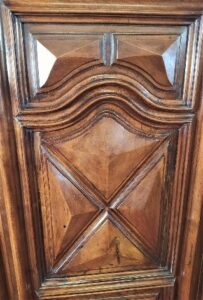
If painting is vision and architecture is space, Emilian cabinetmaking represents their most noble intersection: it is aesthetics transformed into volume and function. In every dovetail joint, in every diamond-shaped panel, in the tension of a serpentine front or in the sinuous lines of Liberty, lies the same quest for balance and refinement pursued by the masters of the Po Valley Renaissance.
The cabinetmaker was not simply a craftsman, but a designer who interpreted regional beauty by using walnut and poplar wood as if they were pigment or marble, conferring artistic value on everyday objects.
Elevating furniture to the status of a work of art means recognising that a double-chest wardrobe or a flared madia are not merely containers, but symbols, tangible testimonies of a culture that has elevated attention to detail and the nobility of materials to universal values.
It is a quiet art form that has successfully conveyed the aesthetics of the great European courts to the elegant simplicity of homes in the lowlands.
In the fifteenth century, following the stagnation of the Middle Ages, a certain focus appeared on the objects that accompanied and facilitated daily life. First and foremost, a distinction emerged between so-called ‘public’ furniture, intended for display, and domestic furniture.
Public furniture, richly carved, worked with tarsie or decorated, displayed in the halls of the courts, reflected an architectural monumentality; furniture for everyday use became increasingly specialised and practical.
The artisanal production of furniture embraced the values and principles of classical art: the lines were clean and precise, but always perfectly harmonious.
Ferrara, Modena, Bologna and Parma emerged as the main centres of regional furniture-making.
Indeed, during the Renaissance, the courts of Emilia were not merely seats of power, but true avant-garde laboratories for European cabinetmaking. Under the patronage of the Este family and other great houses, Emilian furniture charted a unique course, capable of combining architectural vigour with an ornamental sensibility that already foreshadowed modernity.
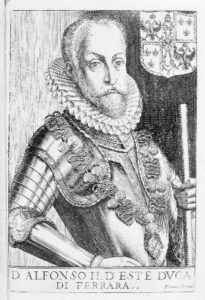
In Ferrara, at the splendid Este Court – first under Nicolò III and later under Alfonso II – furniture attained an unprecedented status as a form of art.
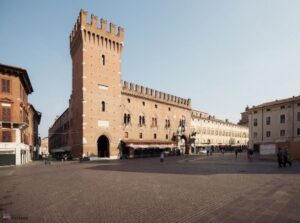
It was the age of tarsia, when wood artists such as the Lendinara family transformed cabinets and wooden choir stalls into intricate scenes and still lifes of astonishing realism. During the reign of Alfonso II, the inlayers and carvers working in Ferrara enriched, both in aesthetic and artistic value, the city residences, the Castle, the Ducal Palace and the country villas of the Este family.
Ferrarese furniture of the 15th and 16th centuries remained, however, austere and solid, defined by remarkable volumes and thickness, with turned woodwork and stud decorations, although the heavy wardrobes featured significant gilded carvings or small carvings depicting naturalistic or classical elements.
Gilding was all the rage in the 16th century, serving as a clear indicator of the economic status of aristocratic families. A distinctive and modern feature of the Este furnishings was their emphasis on functionality and comfort.
When the capital moved to Modena, the style shifted, bringing with it that austere solidity which would become the hallmark of the region. It was here that generously proportioned ‘chestnut and walnut furniture’ was born, where Renaissance lines merged into a more domestic, yet no less elegant, functionality. The House of Este brought to Modena a taste for deep carving: sideboards and chests were adorned with diamond-shaped panels and pilasters that evoked the façades of the city palaces. It was a furniture that commanded respect, built to last thanks to its solidity and simplicity, qualities that would endure throughout the 17th and 18th centuries, and designed to furnish the grand halls of the Este Delizie villas.
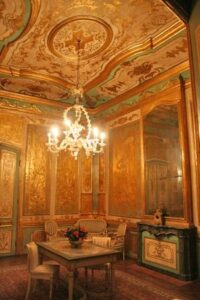
The Baroque evolution manifested primarily in the realm of decoration. Inspiration came from Rome, and the Este court in Modena also adapted to the grandeur of Counter-Reformation Baroque.
The most commonly used decorative motifs were shells, fruit garlands, and gilding. The cabinets, of grand proportions, intended to house collections of precious objects, featured panels decorated with ornamental plaques.
In Modena and Ferrara, the custom of diamond-point reliefs – typical of the House of Este – persisted.
Bologna, a city of learning and commerce, favoured a more ostentatious and vigorous style of luxury. As early as the 16th century, the furnishings crafted in the city displayed more distinctive features than those from other parts of the region, being generally stately and of imposing proportions.
State furniture was decorated with tarsie and carvings, the latter being particularly full-bodied and with a strong realistic accent. Bolognese furniture from the 17th and 18th centuries was renowned for its ‘baccellature’ – decorations consisting of a series of convex elements – and for its use of honey-toned walnut. In Bologna, furniture was transformed into sculpture: lion-paw feet, overhanging cornices and carved friezes spoke of a self-assured wealth. It was a warm, almost carnal cabinetry that reflected the convivial and academic spirit of the city.
As the 18th century progressed, the Baroque elements of Emilian furniture harmonised with Rococo elegance, following the new fashions from across the Alps. In Emilia, work was primarily focused on the voluminous and redundant structure of the furniture; the preference for smaller, more graceful forms led to the creation of lighter carvings, as well as more delicate foliage and scrollwork.
In practice, it was the ornaments that were scaled down, rather than the overall volumetric consistency of the furniture. It was only in the final decades of the 18th century that Bolognese cabinetmakers adapted the shape and dimensions of their pieces, crafting chests of drawers, gaming tables and other items of reduced size, reminiscent of the petits meubles of the Louis XV style.
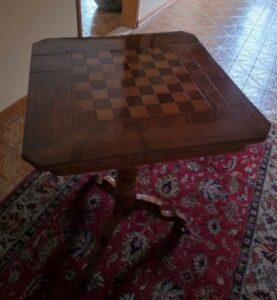
However, it was Parma that established itself as the heart of furniture production. The Farnese court, and later the Bourbon court, opened their doors to French taste. Parmesan furniture was distinguished by an aristocratic harmony, featuring refined lines, the use of exotic woods, and subtle inlays. It was here that Emilian furniture began to engage with European fashion, paving the way for the transition to Neoclassicism, which would strip the forms of all Baroque overabundance.

The presence in Parma, from the second half of the 18th century, of the Bourbon court and, above all, of the refined Louise-Elisabeth, daughter of Louis XV, established the prestige and hegemony of French culture.
Louise-Elisabeth furnished the ducal apartments and country residences with pieces by the most famous Parisian cabinetmakers, such as Charles Cressent and Michel Cresson. Furthermore, the court of Parma employed the eclectic Ennemond Alexandre Petitot, architect and furniture designer, entrusted with the restoration of the ducal palaces and villas.
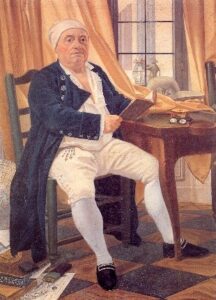
The Rococo style encouraged the creation of furniture more suited to the needs for comfort and elegance required by the society of the time, which definitively abandoned the opulence of Baroque furnishings.
In Parma, the production of everyday furniture demonstrated remarkable technical quality and a consistently high standard of design, from which local craftsmen greatly benefited.
In any case, everyday furniture shared similar characteristics throughout the region: rooted in a distinctly rural and folk tradition, it had a measured and rigorous appearance. However, just like ceremonial furniture, it did not lack the qualities of solidity, sturdiness and volumetric presence that Emilian furniture retained over time, setting it apart from the generic definition of ‘northern Italian furniture’.
A further typical feature was the use of walnut, a wood that adapted to all kinds of furnishings and was exploited by local craftsmen in every shade of colour and variety of combinations. Although considered a noble and rich wood, walnut was used not only by the courts or the bourgeoisie, but also by the humbler classes. In fact, in working-class homes, alongside typical rustic furnishings made from poplar, cypress and elm, which were widespread in the area, one could find prized pieces in walnut, especially nuptial chests containing the bridal dowry.
With the development of 19th-century construction techniques, machinery replaced manual craftsmanship. Within the space of about half a century, the distinctive features of Emilian furniture faded, although the memory of local models managed to survive even within the stylistic heterogeneity of the 19th century, which was, unfortunately, heavily influenced by industrialisation.
The final flourish of craftsmanship is visible in the understated Liberty of Modena and Ferrara, which, while looking towards modernity and industry, does not renounce either raw materials or robustness, but seeks the dynamism of a new verticality.
Over the centuries, this long evolution converged in the Bassa Modenese territory, where the high cabinet-making of the courts met the pragmatic wisdom of the peasantry.
Here, furniture was no longer a symbol of power, but became a tool for everyday life. Entering the homes of the Bassa meant realising that time had been carved into the poplar and walnut wood.
The traditional furnishings of these lands have never been merely a stylistic exercise, but the story of a civilisation that has transformed necessity into elegance.
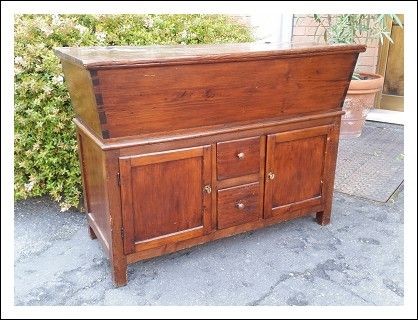
The centre of this world was the Madia, which blended Modenese solidity with the austere lines of 15th-century Ferrarese style. The Madia was the artifact that best embodied the soul of the Bassa Modenese: a piece of furniture that was not merely decor, but a true working tool linked to the daily rhythm of bread and pasta-making. In farmhouses, it was the nerve centre of the kitchen, often positioned near the fireplace or the stove to harness the heat needed for leavening.
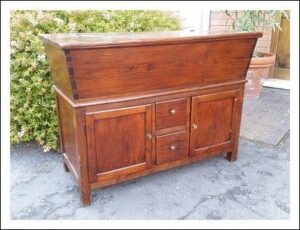
Built in poplar to be lightweight yet sturdy, it was recognisable by its flared, trough-shaped design. The smooth, heavy lid was hinged, serving as a worktop: once opened, it revealed the internal basin, flared and narrower at the bottom to facilitate the gathering of flour and manual kneading. The Madia often rested on a base with doors or drawers, where sacks of flour, salt and the rough hemp towels characteristic of the area were stored.
In the past, the Madia was considered such a valuable asset that it was often included in marriage contracts. Bringing a well-crafted Madia as part of the dowry meant securing the family’s future livelihood.
Moving towards the more secluded areas of the house, the attention inevitably fell upon the double-chest wardrobe, the ‘monument’ of the Bassa Modenese furnishings. It was an imposing piece, born from practical need and logistical ingenuity: since the staircases of old farmhouses were narrow, local cabinetmakers devised a structure that could be split into two stackable sections.
The piece of furniture therefore consisted of two separate chests: the lower one, often featuring drawers or small doors, served as a base, while the upper one was taller and more spacious. A waist moulding concealed the joint, creating the illusion of a single, seamless piece.
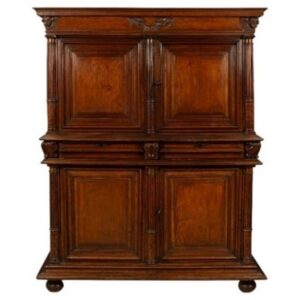
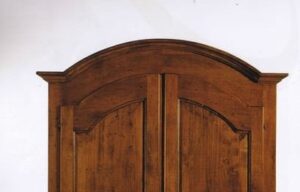
Despite its imposing size, the Bassa wardrobe was remarkably harmonious thanks to the famous ‘gendarme’s hat’ top, a distinctive Emilian trait. The upper section was not flat, but featured a double-curved profile, reminiscent of the hats worn by Napoleonic gendarmes, which softened the austerity of the wooden mass.
The base almost always rested on bun feet or on sturdy bracket feet, which were necessary to support the enormous weight of the solid wood.
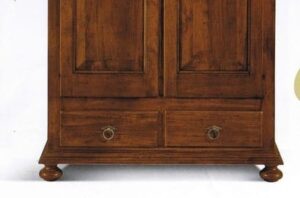
The exterior was crafted from Italian walnut, chosen for its flamed grain, which was book-matched on the doors to create natural decorative patterns. The interior, instead, was made of poplar, a breathable softwood, ideal for preserving linens made of natural fibres.
The double-chest wardrobe was not merely a practical necessity, but it was a status symbol, serving as the centrepiece of a bride’s dowry. Filled with home-woven linens, it was transported by cart on the day of the move to the new home.
Often paired with the wardrobe was the serpentine-front chest of drawers (known as a balestra), a piece of furniture that marked the arrival of a more bourgeois refinement. The peculiarity of this piece, the ultimate expression of the artisanal elegance of the Bassa, lay in the curvature of its front.
Here, the front of the cabinet was not flat, but curved outwards in a convex bulge, reminiscent of the shape of a taut crossbow.
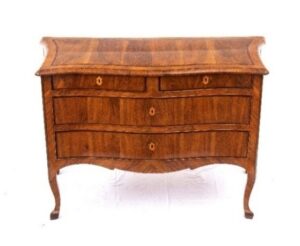
This craftsmanship was the result of exceptional technical mastery, as the wood had to be curved or carved from solid blocks without losing its structural integrity. It usually featured three lower drawers and, occasionally, a slim top drawer with locks for storing documents. Often veneered in precious walnut burl, it symbolised the prosperity achieved, a meeting point between the strength of local materials and a passion for beauty.
Furthermore, in the most prestigious homes of the Bassa, the top was often made of dark marble, such as Bardiglio grey, to create a contrast with the colour of the wood. It was almost always made of Italian walnut, while the finest examples were finished in walnut burl to create book-matched effects, that is, decorative symmetrical patterns.
Sometimes it was fitted with bronze handles, adorned with shell motifs or garlands, essential for adding a touch of light to the dark wood. Paired with a gilded mirror or a carved cresting, it signalled the prosperity achieved by the family.
Three complementary pieces also deserve mention; though secondary, they were nonetheless integral elements of the typical furnishings of the Bassa Modenese.
The pillar bedside table, with its tower-like structure and a single door concealing the compartment for the chamber pot. It was often crafted from the same walnut wood as the a balestra chest of drawers to create a matching set in the bedrooms.
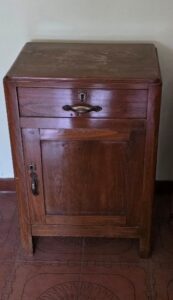
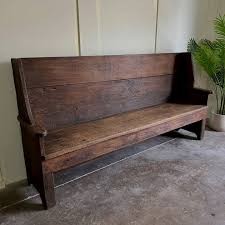
The settle, or fireplace bench, was the ultimate social piece of furniture; long and with a high backrest, often hinged to reveal a storage compartment for firewood.
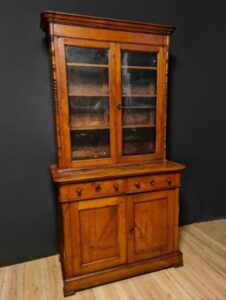
Lastly, the tall, narrow display cabinet, with a glass-paned upper section divided by wooden glazing bars and a closed base. It was typical of farming middle-class families and landowners; proudly displayed in the dining room, it showcased the family’s wealth through its display of porcelains and crystals
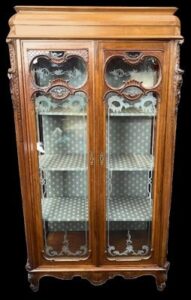
At the dawn of the 20th century, with the advent of the Liberty style, display cabinets began to feature etched glass and decorations with motifs of irises, poppies and ears of wheat.
Throughout its evolution, Emilian furniture, followed the courts of Modena, Ferrara and Parma in looking towards European fashions, yet it preserved a distinct identity. At the same time, local craftsmanship, particularly in the Bassa Modenese, maintained the structural solidity and functionality rooted in peasant civilizati
Translated by the author
Bibliography
- AA.VV., Artigianato e arte del mobile in Emilia Romagna, Bologna/Reggio Emilia, 1980-1990;
- AA.VV., Mobilia e arti decorative in Emilia Romagna, Bologna, BPER, 1980-1990;
- AA.VV., Mobili e arti minori in Emilia-Romagna, Bologna/Reggio Emilia, 1985;
- AA.VV., Mobili e decorazioni d’interni tra XVII e XIX secolo, Bologna, CLUEB, 1980-1985;
- AA.VV., Mobili e oggetti d’arte applicata in Emilia-Romagna, Bologna, CLUEB, 1980-1985;
- AA.VV., Storia del mobile in Emilia Romagna, Bologna, Infor-Restauro, 2000-2010;
- E. Barbolini Ferrari, G. Boccolari, Arredo domestico. Secoli di cultura popolare in Emilia-Romagna, Bologna, Calderini, 1998;
- E. Barbolini Ferrari, Mobili impero in Emilia Romagna, Bologna, Calderini, 1999;
- G. Franzoni, Mobili e decorazioni d’interni in Emilia-Romagna, Bologna, 1980;
- G. Manni, I mille mobili emiliani, Firenze, Polistampa/Ed. delle Arti, 2000;
- G. Manni, Mille mobili emiliani. L’arredo domestico in Emilia Romagna dal sec. XVI al sec. XIX, Modena, Artioli, 1991;
- G. Pedretti, Il mobile in Emilia tra Rinascimento e Neoclassicismo, Bologna, ed. varie;
- C. Pedretti, Mobilia e decorazione d’interni in Emilia Romagna, Bologna, 1980-1990;
- G. Prampolini, L’arte del legno in Emilia Romagna, Bologna, 2002.