Roberta Paltrinieri – Perle di Cultura – Cardinal Pico della Mirandola: The shadow of the papacy and the light of relics

Born in Mirandola, she holds multiple Master’s Degrees from the Alma Mater Studiorum, University of Bologna, having developed a distinguished multidisciplinary profile in philosophy, literature, history and the arts. She founded her own Studio Didattico, a private teaching school, where she taught for over twenty years as a private tutor and learning coordinator. Alongside this activity, she spent fifteen years teaching humanities in public secondary schools in the province of Modena. Over the years, she has also supplemented her studies with specialisation courses at prestigious Italian foundations.
A former editor of art texts and author of handbooks on various specialised topics, she has conducted seminars and lecturers also abroad in Italian art.
She maintains ongoing professional collaborations in various capacities with university professors in Italy and abroad.
She is an independent researcher, writer and ghostwriter.
Her collaboration with Al Barnardon is driven by the conviction that local culture in all its facets, from art to history, literature to philosophy, and traditions, represents an invaluable heritage to be supported and enhanced.
CARDINAL PICO DELLA MIRANDOLA: THE SHADOW OF THE PAPACY AND THE LIGHT OF RELICS
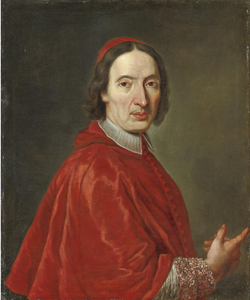
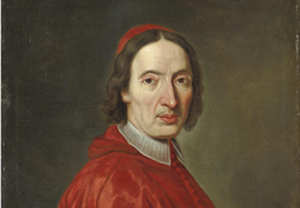
Ludovico Pico was born in 1668, the last male child of the Duke of Mirandola Alessandro II and Anna Beatrice d’Este. He spent his youth in Mirandola where he was tutored in his studies first by the Somascan father Leonardo Bonetti and later by Fulvio Tangerini, a friar, theologian and court diplomat. After earning his doctorate in utroque iure, a title conferred upon graduates in both Civil and Canon Law, he was destined for a religious life as early as 1683. Following his father’s death in 1691, he became involved in the difficult situation of the Duchy, which passed to his nephew Francesco Maria, son of his deceased brother Francesco, under the guardianship of his aunt Brigida.
In 1693 he was forced to leave Mirandola following the accusations made by Brigida, who charged him and his brothers Galeotto and Giovanni with the attempted poisoning of Francesco Maria.
He was consequently forced into exile, moving first to Bologna, then to Vienna at the court of Emperor Leopold I of Habsburg, where he went on the advice of Cardinal Rinaldo d’Este. Although the Imperial Court, to which he had appealed, cleared him and his brothers of the poisoning charges, he was ordered not to return to Mirandola to avoid disrupting the fragile political balance that had been achieved.
He then moved to Rome, where he began his brilliant ecclesiastical career holding numerous prestigious positions: in 1706 he was appointed Chamberlain to Clement XI, Patriarch of Constantinople and Assistant to the Pontifical Throne; in 1707 he was Prefect of the Apostolic Palace and Governor of the Palace of Castel Gandolfo; in 1712 he was created Cardinal and in 1717 Chamberlain of the College of Cardinals and Archbishop of Senigallia; in 1724 he became Prefect of the Congregation for Indulgences and Sacred Relics; in 1728 he was named Cardinal-Priest of Santa Prassede, followed by two further ordinations in 1731 as Cardinal-Bishop of Albano and in 1740 of Porto and Santa Rufina.
However, the highlight of his ecclesiastical career was his participation in four conclaves, in 1721, 1724, 1730 and 1740. While his name was briefly considered among the possible candidates in the 1721 conclave, it was in 1730 that Cardinal Annibale Albani formally proposed Pico’s candidacy, but he was not elected due to the opposition of the emperor, who succeeded in mobilising 25 Cardinals against him, a manoeuvre that prompted Pico to withdraw his candidacy. In the conclave of 1740, Cardinal Pico again emerged as a potential compromise candidate between the Albani and Corsini factions. Although ultimately unsuccessful, he remained a figure of great prominence and power within the 18th-century Roman Curia.
In his capacity as a Prince of the Church his artistic and religious patronage was highly successful, particularly in the relocation of ancient relics and the promotion of significant decorative interventions aimed at enhancing the artistic and spiritual heritage of places of worship. The search for relics responded to a requirement of the Roman Church established by the Council of 1725, which mandated that the Titular Cardinals of the Basilicas conduct an official recognition of the relics preserved under the altars with the aim of verifying their authenticity and ensuring their proper preservation.
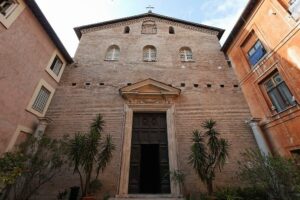
Ludovico Pico served as the Cardinal-Priest of Santa Prassede from 1728 to 1731, the central period of the research work. Furthermore, from 1724 he held the office of Prefect of the Congregation for Indulgences and Sacred Relics, a title that made him particularly qualified for this type of investigation. His most significant achievement as Cardinal of the Basilica di Santa Prassede was the discovery of the relics of the titular Saint and of Saint Pudentiana, the reason why his image has been immortalised within this historic building. In addition to the Saints’ relics, Pico also rediscovered the tomb of Pope Paschal I. In fact, upon the Pope’s death in 824, the Roman people, due to political tensions, denied him burial in San Pietro, consequently, his successor, Pope Eugene II, had him buried in Santa Prassede.
The Cardinal ordered excavations beneath the high altar, erected by Pope Paschal I in the 9th century, with the intention of finding the original burials of Saint Praxedes, her sister Pudentiana and other Martyrs. The excavations, which took place between 1728 and 1734, brought to light two precious ancient sarcophagi, marked with the names of Saint Praxedes and Saint Pudentiana, thus confirming that the remains of the two Saints had been identified.
To provide a worthy setting for the relics Pico entrusted the reorganisation of the presbytery and crypt to the architect Francesco Ferrari. Active in Rome during the first half of the 18th century and a member of the Accademia di San Luca, Ferrari was highly successful in restoring ancient Roman churches, following the guidelines of a more cautious papal building policy after the splendour of the 17th century.
The works, commissioned and constantly overseen by Cardinal Pico, involved the renovation of the presbytery and the crypt.
The presbytery area was modified with the construction of a balustrade and the addition of stairs leading to the altar. In the 1798, during the occupation of Rome by Napoleonic troops, the steps made of magnificent rosso antico marble were nearly dismantled and transported to France by order of Napoleon, who desired the marbles for his imperial throne.
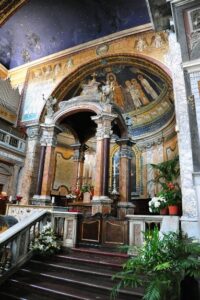
In addition to the two lateral flights of stairs ascending towards the altar, a descending one was built leading to the crypt, where the sarcophagi containing the holy relics were found. Thus, a central access to the crypt was created in the form of a small oblique corridor, situated where there had previously been a storage chamber for the many relics moved from the Catacombe di Priscilla by Pope Paschal I, including those of Praxedes, Pudentiana and their father Pudens.
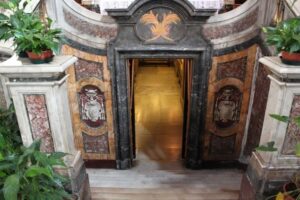
The corridor ends with a small altar embellished by a Cosmatesque marble antependium with geometric and polychrome decorations. Above the altar is an 18th-century fresco, a recreation of the one that existed in the ancient relic chamber which had been destroyed.
Cardinal Pico had four strigilated tub-shaped sarcophagi placed on the sides of the corridor, stacked two by two and separated by marble bands. On the lower right is the sarcophagus containing the relics of Saint Praxedes, while the others house the remains of Saint Pudentiana, the Martyrs and the Pope Paschal I.
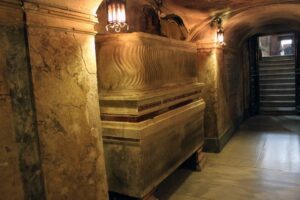
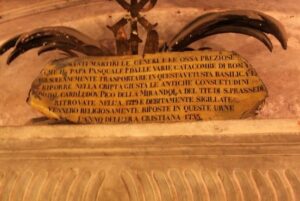
Above the marble containers are placed two cartouches, in Latin and Italian, which report how “the ashes and precious bones” of the holy Martyrs translated by Pope Paschal I were “by Cardinal Ludov. Pico della Mirandola…rediscovered in the year 1729 and duly sealed, were religiously replaced in these urns in the year of the Christian era 1735”.
The head of Praxedes, however, is located in the papal altar of the Sancta Sanctorum in the Pontifical Sanctuary of the Scala Santa in Rome. The precious Byzantine silver reliquary containing it was exhibited at the Vatican Library Museum from 1905 to 1907. Part of the relics of Saint Pudentiana was also translated in 1803 beneath the high altar of the Basilica that bears her name.
At the back of the crypt, a black marble slab was placed; according to legend, this was the stone on which Praxedes slept to mortify her flesh and which was used to seal her tomb. On either side are two frescoes depicting the Saint’s parents, Pudens and Savinilla (or Sabina).
The renovation commissioned by Cardinal Pico served a dual purpose: to authenticate and enhance the value of the rediscovered relics, exhibited in the crypt ever since, and to modernise the presbytery, giving it a more harmonious appearance consistent with the late Baroque style of the period.
For the occasion, a commemorative painting entitled “Saint Praxedes collecting the blood of the Martyrs” (1735) was also commissioned from Domenico Maria Muratori; by celebrating the Saint’s act of piety, it became the visual centrepiece of the presbytery renovated by Pico.
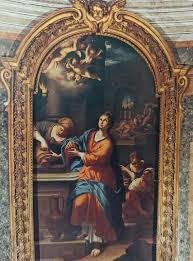
The painting recalls what the Roman Leggendari, accounts composed between the 5th and 6th century and widely circulated in the Middle Ages, report regarding the life and works of the Martyr.
The Roman senator Pudens, father of Praxedes and Pudentiana, was among the first high-ranking converts to Christianity, followed by the conversion of his daughters.
Pudens owned a villa – the remains of which lie 9 meters below the current Basilica, and to which the four red porphyry columns of the ciborium bear witness – where he used to hide persecuted Christians.
When Pudens suffered martyrdom, Praxedes and Pudentiana, with the consent of Pope Pius I, had a baptistery built in the church founded by their father. Pudentiana also suffered martyrdom during the persecutions of Antoninus Pius, which lasted throughout the emperor’s reign from 138 to 161 A.D. These were not systematic persecutions, but death sentences based primarily on individual denunciations and fanaticism, rather than on a general imperial edict.
Upon her sister’s death, Praxedes used the family estate to build a church “sub titulo praxedis”, as recorded by a later inscription dating to 491 A.D. The young woman hid many persecuted Christians and collected the bodies of the martyred to bury them in the Catacombe di Priscilla on the Via Salaria, where she also found burial alongside her sister and father after her own martyrdom.
Some hagiographic accounts narrate that Praxedes and Pudentiana buried the Martyrs in wells located within their father’s vast estates, while others report that the young woman collected the blood of the martyred, later emptying it into a well. Both actions, however, seem improbable: the first because decomposing bodies would have contaminated the well water and the surrounding countryside, causing an unbearable stench and widespread epidemics, and the second because collecting the blood of the deceased was completely unusual at that time.
The current church is the result of the reconstruction by Pope Paschal I in 817, who built a new sacred edifice in the place of the previous one to house the bones of 2300 Martyrs. These remains, primarily buried in the Catacombe di Priscilla, were brought inside the city by the Pope on January 20, 817, and distributed among various churches. At Santa Prassede, they were placed in the crypt beneath the high altar, where numerous relics from the Catacombe di Sant’ Alessandro on the Via Nomentana were also translated.
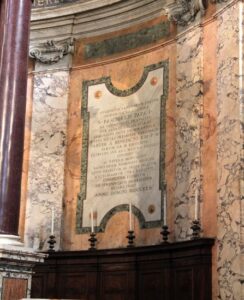
After a life dedicated to the Church, Cardinal Ludovico Pico died in Rome on August 10, 1743, in his palace near the Basilica dei Santi XII Apostoli, where his funeral was held. His body was then transferred to the new church of SS. Nome di Maria at Trajan’s Column, also in Rome. He had been a generous benefactor of this church, promoting its construction in 1738, and was buried there according to his wishes. A plaque near the high altar commemorates the illustrious Cardinal. In Santa Prassede, however, Cardinal Angelo Maria Querini, an erudite, collector and the Cardinal Titular of the Basilica, composed and read a funeral eulogy in honour of his great predecessor. Furthermore, in Santa Prassede, for which Cardinal Pico had shown such commitment and devotion, a marble tablet dated 1730 stands at the side of the presbytery, commemorating his meritorious work.
As a testament to his faith and devotion to the Church, Cardinal Pico left a legacy in his will for 300 Masses, 200 in the churches of Rome and 100 in the diocese of Albano where he had served as Cardinal Bishop.
Translated by the author
Bibliography:
- G. Paviolo, I testamenti dei cardinali: Ludovico Pico della Mirandola (1668-1743), Lulu, 2019 S. Tabacchi, Pico Ludovico, in Dizionario Biografico degli italiani, in Enc. Treccani, vol.83, 2015
- Ceretti, Biografie pichensi, III, Mirandola, 1911
Ludovico Pico della Mirandola, in www.cathopedia.org
Pico della Mirandola Ludovico, in www.performart.huma-num.fr
- Ballardini, M. Caperna, A Santa Prassede nella Gerusalemme nuova, in Convivium, Univ. Masaryk, Brno, 2020
- Caperna, La basilica di Santa Prassede: il significato della vicenda architettonica, Quasar, Roma, 2014
- Gallio, La basilica di Santa Prassede, Ed. Marconi, Genova, 2000
- Rendina, Le chiese di Roma, Newton Compton, Roma, 2000
Storia della Roma papale. Basilica di Santa Prassede, in www.borgato.be
C.G. Coda (a cura di), Duemilatrecento corpi di martire: la relazione di Benigno Aloisi (1729) e il ritrovamento delle reliquie nella basilica di S. Prassede in Roma, Roma, 2004
- Federici, La notitia martyrum di S. Prassede, in Bollettino storico italiano per il Medio Evo, 1949 H. Delehaye, Les légendes hagiographiques, Bruxelles, Société des Bollandistes, 1905
- Delehaye, Étude sur le Légendier romain: les saints de novembre et de décembre, Bruxelles, Société des Bollandistes, 1936
Santa Prassede di Roma, martire in www.santiebeati.it