Roberta Paltrinieri – Perle di cultura – The Mysterious ophitic column of Santa Maria delle nevi in Quarantoli

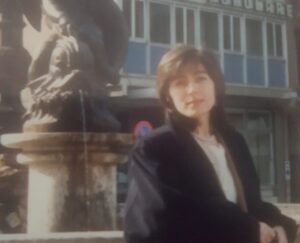
Born in Mirandola, she holds multiple Master’s Degrees from the Alma Mater Studiorum, University of Bologna, having developed a distinguished multidisciplinary profile in philosophy, literature, history and the arts. She founded her own Studio Didattico, a private teaching school, where she taught for over twenty years as a private tutor and learning coordinator. Alongside this activity, she spent fifteen years teaching humanities in public secondary schools in the province of Modena. Over the years, she has also supplemented her studies with specialisation courses at prestigious Italian foundations.
A former editor of art texts and author of handbooks on various specialised topics, she has conducted seminars and lecturers also abroad in Italian art.
She maintains ongoing professional collaborations in various capacities with university professors in Italy and abroad.
She is an independent researcher, writer and ghostwriter.
Her collaboration with Al Barnardon is driven by the conviction that local culture in all its facets, from art to history, literature to philosophy, and traditions, represents an invaluable heritage to be supported and enhanced.
THE MYSTERIOUS OPHITIC COLUMN OF SANTA MARIA DELLA NEVE IN QUARANTOLI
The Romanesque Pieve di Santa Maria della Neve in Quarantoli, Mirandola, houses an architectural artifact of great significance, both for its form and the rarity of such specimens: an ophitic column. The defining characteristic of this original element is the impossibility of assigning it a single interpretation, as it is linked to various different meanings, including esoteric ones.
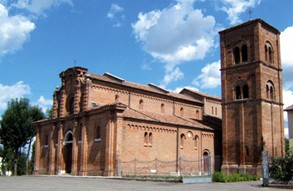
The church, already established in the 9th century and documented since 1044, was entirely rebuilt in the 12th century according to the canons of the Romanesque architecture at the behest of Matilde of Canossa. Following 15th century restorations, the Pieve was transformed in 1670 according to the Baroque style, which is still distinguishable on the facade.
The current building is a reconstruction resulting from the controversial restoration works carried out by Archpriest Don Alberto Fedozzi between 1915 and 1945; on one hand, these interventions sought to highlight the Romanesque features, but on the other, they introduced rather radical changes, such as the presbytery with an ambulatory inspired by the Paleo-Christian models of Ravenna.
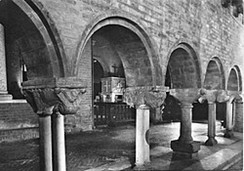
The actual structure of the Romanesque church features a basilica plan with three naves and a truss roof, while the perimeter walls and internal colonnades have been rebuilt.
The most interesting elements attributable to the original phase of the Pieve are the sculptural furnishings: the pulpit, resting on two stone telamons with embedded Romanesque sculptures depicting the symbols of the four Evangelists, dating between the 12th and 13th centuries and attributed to the school of Wiligelmo; a loggia constructed with reused crutch capitals on small columns, likely originating from a lost cloister.
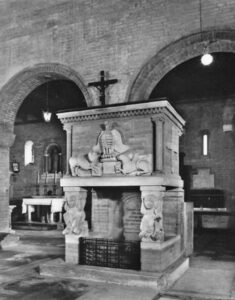
Particularly singular is the high altar, composed of elements certainly belonging to the Pieve. Built in a simple manner, the altar consists of a dressed stone mensa with Roman numerals and Latin words engraved upon it “MCXIIII indictione VIII-XVII Kalendis decembris”, 15 November 1114, the date of the consecration. It is supported by two late-Romanesque pillars of exquisite workmanship, attributed to craftsmen active at the construction of the Duomo di Modena. The refined pillar on the left is surmounted by a cubic capital, finely engraved with leaning foliage.
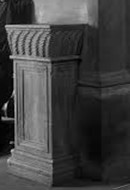
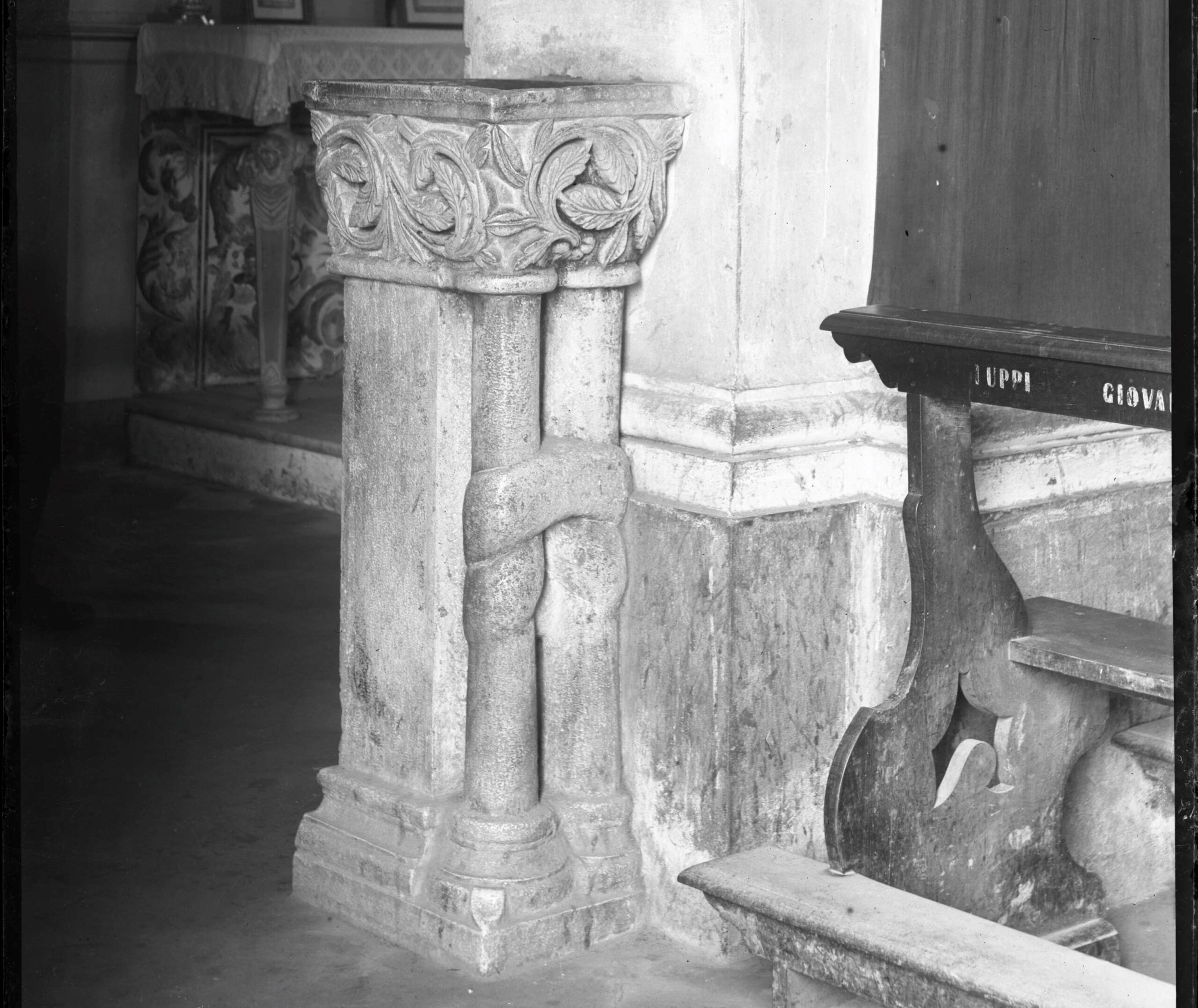
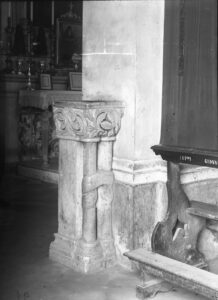
The pillar on the right is undoubtedly the most peculiar: it features a volute capital with a distinct decoration of leaves and branches resting on ophitic or knotted columns.
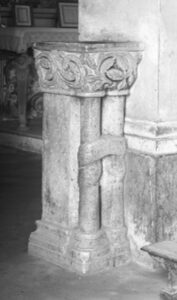
The term “ophitic columns”, otherwise known as “knotted columns”, refers to an architectural element composed of two columns joined by a reef knot. The term ophitic derives from the Greek ophis, meaning snake, which the twisting of the knot around the two sculptural elements vaguely resembles.
Known examples of ophitic columns are found almost exclusively in religious building of the Romanesque period. In addition to the Pieve di Santa Maria della Neve, one of the oldest specimens along with the Pieve di Gropina in the province of Arezzo, these columns are also found in other significant places of worship, such as, to mention only the closest ones, the Duomo di Modena and Ferrara, the Basilica di San Zeno in Verona and San Marco in Venice, the Cistercian Abbazie di Chiaravalle Milanese and Chiaravalle della Colomba in the province of Piacenza, and the church of San Michele in Pavia.
Information regarding this particular typology is quite scarce, as it is gone almost unnoticed or has been superficially dismissed as a mere ornamental device created by the sculptor’s inventiveness.
However, during the Middle Ages the column did not represent a merely structural or decorative element but evoked multiple meanings. For this reason, the ophitic column is of specific interest; indeed, one wonders what interpretations should be attributed to this architectural feature, which is quite rare and limited to specific areas, and what contents it could have represented for contemporaries.
The most easily deducible explanation for the meaning of ophitic column derives from their territoriality, as they may have been used as a distinctive mark by a particular guild or a specific family of builders or Comacine Masters (Maestri Comacini). In fact, these columns are found wherever the Comacine Masters provided their constructive and artistic skills, thus becoming a materialisation of their professional presence. But who were these craftsmen and artists? The Comacine Masters were building guilds, masons, stonecutters, plasterers and sculptors, active primarily between the 7th and 13th centuries, originating from the area between Lake Como, from which the etymology derives, and the Canton of Ticino.
The first evidence of the Comacine Masters dates back to the 7th century, when they were mentioned by the Lombard King Rothari in his Edict of 643, where they are referred to as “workers of the Sacred” (laboratores sacri). The Comacines were itinerant craftsmen; they moved mainly throughout Northern and Central Italy, but also to Switzerland, Germany and France, often along pilgrimage routes, spreading construction techniques and decorative styles.
Their symbolic ornamental apparatus was highly evocative, characterised by interlaced patterns, geometric motifs, and capitals carved with chimerical and zoomorphic figures, telamons and Christian symbols. Among the iconographic and allegorical elements, the Comacine Masters favoured plant motifs, labyrinths and columns, particularly ophitic ones.
These master craftsmen worked anonymously; however, in addition to the stylistic recognisability of the Romanesque buildings where they operated, the presence of ophitic columns can therefore be considered a sculptural signature.
A second interpretation of this architectural singularity is related to their position within place of worship.
In fact, an apotropaic or protective function is associated with ophitic columns due to their presence at access points or at the boundaries of the sacred space. An analysis of the sites where they have been found has highlighted a pattern of use directly linked to this apotropaic function. Indeed, ophitic columns are essentially located along the “limen sacrum” (sacred threshold), that is in the entrance portal, in the perimeter mullioned windows, or at the boundary of the cloister space, thus emphasising a protective intent against negative influences or evil spirits, connected to ancient religious and mystical traditions.
The symbolic purpose of protecting the place of worship and warding off evil spirits links ophitic columns to the powerful biblical archetype of the mythical Jachim and Boaz, the columns of the Temple of Salomon in Jerusalem. These columns delimited the vestibule of the sacred building (1 Kgs 7:15-22; 2 Chr 3:15-17) and, in addition to protecting the Temple, they also metaphorically marked the initiatory boundary between the earth and the afterlife.
An example of the function of separation between the world of the living and that of the dead attributed to ophitic columns can be observed in the Duomo di Modena. Here, the columns are placed at the side entrance in the so-called “Porta Regia”, which delimits the cathedral from the current Piazza Grande; in the subsoil of this square was located the city’s largest Roman necropolis.
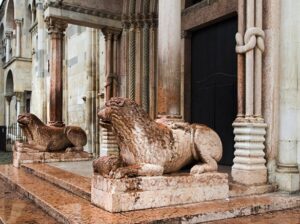
Another explanation for the significance and presence of these columns is provided by the reef knot (or “plain knot”) that characterises them. Considered to be a depiction of Salomon’s Knot, the reef knot is also reinterpreted as a symbol of protection, a sort of barrier, since in ancient times the geometric interlacings of which it was formed were believed to possess the occult power to dispel witchcraft and hexes.
This type of knot used by Romanesque craftsmen could be referred to both the biblical Salomon’s Knot and the Knot of Hercules, as the two interlacings are practically interchangeable in form. The knot of the mythical Greek hero was probably more popular; in fact, numerous Roman depictions showed Hercules, having completed his first labour, tying the skin of the Nemean lion around his neck. Since antiquity, the Hercules knot, represented in homes and in battle, was attributed an apotropaic function in warding off danger and the forces of evil, a characteristic it maintained even after the advent of Christianity.
The fear of God, ever present in the daily lives of Medieval people, and the hope for a better life in the hereafter, motivated a profound devotion that also manifested in pilgrimages for the salvation of the soul.
To this aspect, a further meaning of the ophitic columns can be linked. Depending on the buildings where they were placed, they might represent a sort of “landmark”, indicators of places of worship considered to be of particular significance. As can be easily inferred from the group of religious buildings where the Comacine Masters worked, their importance can be attributed both to their value for the local territory and the religious community, and to their proximity to the major pilgrimage routes that were heavily travelled during the Middle Ages.
Beyond all the concepts and interpretations addressed so far, the spiritual value of this architectural element is undoubtedly the most important. Indeed, the ophitic column embodies a profound Christological meaning: in biblical sources, Christ is defined as a Temple that encompasses the concept of the Sacred (John 2:19-21). Christ is the one who defeats evil, thus fully embodying the apotropaic function architecturally evoked at the “limen sacrum”.
The ophitic column is, therefore, an image of Christ: He is the knot that unites Earth and Heaven through His dual nature, both human and divine.
Furthermore, the two columns and the knot that binds them have been symbolically interpreted as elements of the mystery of the Divine Trinity. There is but one God in three persons, there is but one architectural element in three parts: the Father and the Son are represented by solid columns, reaching toward heaven and the spiritual afterlife, while the knot represents the Holy Spirit, the divine love that unites and elevates.
The mystery of the Incarnation of the Son of God is also present in the knotted columns. In Christ, two natures, the divine and the human, condense, represented by the columns; yet there is only one person, the Divine one, made visible by the knot that unites the two natures.
In this spiritual contest, the knot could also be interpreted as an image of the solid union between people of faith and the religious ideals they testify to, and to God. Furthermore, since these columns are found in various abbeys, the knot could further confirm and sustain the mutual bond that supports monks in their testimony of faith and conformity to the Rule.
Beyond the intrinsic theological meaning, we cannot determine the original purpose the small pillar with ophitic columns served at the moment it was placed in Santa Maria della Neve. In fact, a late 19th or early 20th century photograph from the Catalogo generale dei beni culturali shows the small pillar placed against a wall; only later it was used as a support for the altar table. We do not know, therefore, whether the ophitic column was originally placed near the entrance portal to fulfil its protective function, whether it merely testified the presence of the Comacine Masters in the area, or it confirmed the importance of the Pieve for the local community and the travellers, due to its proximity to the great pilgrimage routes. Nevertheless, it is undeniable that, regardless of its original function, the presence of this architectural rarity further embellishes the Pieve of Quarantoli.
Translated by the author
BIBLIOGRAPHY
- La Pieve di Santa Maria della Neve in Quarantoli secolo XII. Guida storico artistica, Editrice Teic, Modena, 1972
- Pieve di Santa Maria della Neve a Quarantoli di Mirandola, in Ars Romanica, 6 aprile 2012
- C. Tosco, L’architettura medievale in Italia. 600-1200, Bologna, Il Mulino, 2016
- W. Ravenscroft, The Comacines: their predecessors and they successors, Forgotten Books, 2018
- F. Reggiori, Comacini Maestri, in Enciclopedia Treccani.it
- Quarantoli, Mo, chiesa parrocchiale, frammenti di sculture. Riprese della pieve di Santa Maria della Neve di Quarantoli durante i restauri (8 lastre), in Catalogo Generale dei Beni Culturali
- M. Uberti, L’enigmatica colonna annodata, in www.duepassinelmistero.com
- S. Corrente Naso, Le colonne ofitiche, funzione e simbologia, in Simboli, 28/12/2014
- F. Folloni, Misteri modenesi. Le colonne annodate e i segreti esoterici di San Geminiano, in Modena Today, 22/07/2016
- Italia nell’arte medievale, Il duomo di Modena, in www.medioevo.org
- Valente Moretti, Il pulpito di Gropina. Una splendida meditazione sulla vita di fede, Calosci ed., Cortona, 2004