Roberta Paltrinieri – Perle di Cultura – Il cardinale Pico della Mirandola: l’ombra del papato e la luce delle reliquie.

Née à Mirandola, elle est titulaire de plusieurs diplômes de Master 2 (M2) de l’Alma Mater Studiorum, Université de Bologne, avec un profil multidisciplinaire d’excellence en philosophie, littérature, histoire et arts.
Elle a fondé son propre Studio Didattico, une private teaching school, où elle a enseigné pendant plus de vingt ans en tant que private tutor and learning coordinator.
Parallèlement à cette activité, elle a exercé pendant quinze ans comme enseignante de matières littéraires dans les établissements publics de la province de Modène.
Au fils des ans, elle a également complété sa formation par des parcours de spécialisations auprès de prestigieuses fondations italiennes.
Ancienne rédactrice de textes d’art et auteure de fascicules thématiques sur divers sujets spécialisés, elle a animé des séminaires et des conférences également à l’étranger sur l’art italien.
Elle collabore régulièrement à différents titres avec des professeurs d’université en Italie et à l’étranger.
Elle est chercheuse indépendante, écrivaine et ghostwriter.
Elle a entrepris sa collaboration avec Al Barnardon portée par la conviction que la culture locale, sous toutes ses facettes, de l’art à l’histoire, de la littérature à la philosophie et aux traditions, constitue un patrimoine inestimable qu’il convient de soutenir et de valoriser.
LE CARDINAL PICO DELLA MIRANDOLA : L’OMBRE DE LA PAPAUTÉ ET LA LUMIÈRE DES RELIQUES
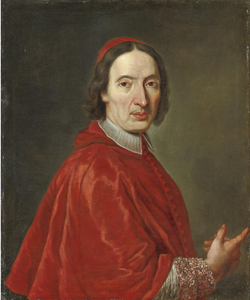
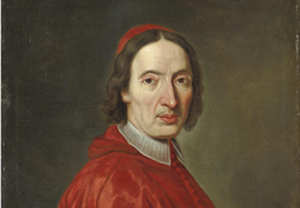
Ludovico Pico naquit en1668, dernier fils du duc de Mirandola Alessandro II et de Anna Beatrice d’Este. Il passa sa jeunesse à Mirandola, suivi dans ses études par le père somasque Leonardo Bonetti, puis par Fulvio Tangerini, frère, théologien et diplomate de cour. Après son doctorat in utroque iure, titre conféré aux diplômés en droit civil et en droit canonique, il fut destiné à la vie religieuse dès 1683. Après la mort de son père en 1691, il fut impliqué dans la situation difficile du duché, qui passa à son neveu Francesco Maria, fils de son frère décédé Francesco et placé sous la tutelle de sa tante Brigida.
En 1693 il fut contraint d’abandonner Mirandola suite aux accusations de Brigida, qui lui imputait, ainsi qu’à ses frères Galeotto et Giovanni, la tentative d’empoisonnement de Francesco Maria.
Il fut donc contraint à l’exil, d’abord à Bologna, puis à Vienne auprès de l’empereur Léopold Ier de Habsbourg, où il se rendit sur le conseil du cardinal Rinaldo d’Este. Le tribunal impérial, auquel il avait fait appel, le disculpa ainsi que ses frères de l’accusation d’empoisonnement, mais lui imposa de ne pas retourner à Mirandola afin de ne pas troubler les fragiles équilibres politiques atteints.
Il s’installait ensuite à Rome, où il commença sa fulgurante carrière ecclésiastique en occupant de nombreuses et prestigieuses fonctions : en1706 il est Maître de la Chambre de Clemente XI, Patriarche de Constantinople et Assistant au Trône Pontifical; en1707 il est Préfet du Palais Apostolique et Gouverneur de Castel Gandolfo; en 1712 il est nommé Cardinal et en 1717 il devient Camerlingue du Sacré Collège et Archevêque de Senigallia; en 1724 il est Préfet de la Congrégation des Indulgences et des Saintes Reliques; en 1728 il est nommé Cardinal-Prêtre de Santa Prassede, puis suivirent deux autres ordinations, en 1731 comme Cardinal-Évêque d’Albano et en 1740 de Porto et Santa Rufina.
Toutefois ce qui marca sa carrière ecclésiastique fut sa participation à quatre conclaves en 1721, 1724, 1730 et 1740. Si son nom circula brièvement parmi les papables lors du conclave de 1721, c’est en 1730 que le Cardinal Annibale Albani avança la candidature de Pico, qui ne fut pas élu en raison de l’opposition de l’empereur, qui réussit à mobiliser contre lui 25 Cardinaux, une manœuvre qui poussa Pico à renoncer à sa candidature. Lors du conclave de 1740 également, le Cardinal Pico émergea comme un possible candidat de compromis entre les factions des Albani et des Corsini, malheureusement sans succès, mais il représentât toujours une figure de proue et de pouvoir au sein de la Curie romaine du XVIIIe siècle.
En sa qualité de prince de l’Église, son activité de mécénat artistique et religieux connut un grand succès, particulièrement à travers la translation des reliques anciennes et la promotion d’importantes interventions décoratives qui valorisèrent le patrimoine artistique et spirituel des lieux de culte.
La recherche des reliques répondait à une exigence de l’Église romaine, établie par le Concile de 1725, qui imposa aux Cardinaux Titulaires des basiliques la reconnaissance officielle des reliques conservées sous les autels dans le but d’en vérifier l’authenticité et la conservation appropriée.
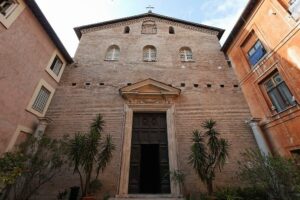
Ludovico Pico fut le Cardinal-Prêtre de Santa Prassede de 1728 à 1731, période centrale des travaux de recherche et de plus dès 1724 il occupa la fonction de Préfet de la Congrégation pour les Indulgences et les Saintes Reliques, un titre qui le rendait particulièrement qualifié pour ce type d’investigations. Sa réalisation la plus importante en tant que Cardinal de la Basilique de Santa Prassede fut la découverte des reliques de la sainte titulaire et de sainte Pudentienne, raison pour laquelle son image a été immortalisée dans cet édifice historique. Outres les reliques des saintes, Pico retrouva également le tombeau du pape Paschal Ier ; en effet, à la mort du pontife en 824, le peuple romain, en raison de tensions politiques, lui refusa la sépulture à San Pietro, c’est pourquoi son successeur, le pape Eugène II, le fit ensevelir à Santa Prassede.
Le Cardinal ordonna de creuser sous le maître-autel, édifié par le pape Pachal Ier au IXe siècle, avec l’intention de retrouver les sépultures originales de sainte Praxède, de sa sœur Pudentienne et d’autres martyrs. Les fouilles, qui eurent lieu entre 1728 et 1734, mirent au jour deux précieux sarcophages antiques, marqués des noms de sainte Praxède et sainte Pudentienne, confirmant ainsi que les dépouilles des saintes avaient été identifiés.
Pour abriter dignement les reliques, Pico confia les travaux de réorganisation du presbytère et de la crypte à l’architecte Francesco Ferrari. Actif à Rome dans la première moitié du XVIIIe siècle et membre de l’Académie de Saint-Luc, Ferrari s’illustrait avec grand succès dans la restauration des églises romanes antiques, suivant les orientations d’un politique de construction pontifical plus prudente après les fastes du XVIIe siècle.
Les travaux commandés, et constamment supervisés par le Cardinal Pico, comprirent la restructuration du presbytère et de la crypte.
L’espace du presbytère fut modifié par la construction d’une balustrade et l’ajout d’escaliers menant à l’autel. Les marches, faites d’un splendide marbre rouge antique, risquèrent en 1798, durant l’occupation de Rome par les troupes napoléoniennes, d’être démontées et transportées en France sur ordre de Napoléon, qui aurait souhaité ces marbres pour son trône impérial.
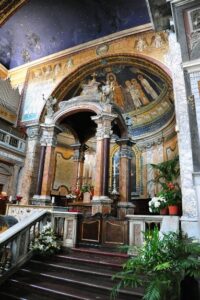
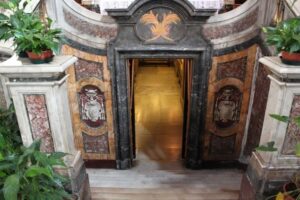
Outre les deux volées d’escaliers latérales montant vers l’autel, une troisième fut construite, descendante, menant à la crypte où furent trouvés les sarcophages contenant les reliques des saintes. Un accès central à la crypte fut ainsi réalisé, sous la forme d’un petit couloir oblique, là où existait auparavant une chambre de dépôt pour les nombreuses reliques déplacées du cimetière de Santa Priscilla par le pape Paschal Ier, y compris celles de Praxède, Pudentienne et de leur père Pudent.
Le couloir se termine par un petit autel orné d’un devant d’autel en marbre cosmatesque aux décorations géométriques polychromes. Au-dessus de l’autel se trouve une fresque du XVIIIe siècle, réfection de celle qui existait dans l’ancienne chambre des reliques et qui fut détruite.
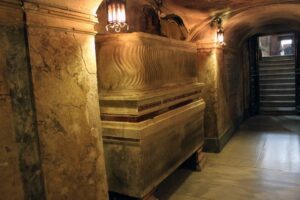
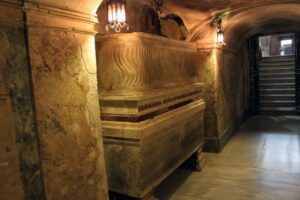
Le Cardinal Pico fit installer sur les côtés du couloir quatre sarcophages à cuve strigilée, superposés deux à deux et séparés par des bandes de marbres. Sur la droite, en bas, se trouve le sarcophage contenant les reliques de sainte Praxède, tandis que les autres conservent les restes de sainte Pudentienne, des martyrs et du pape Paschal Ier.
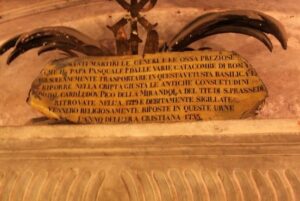
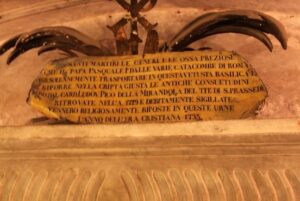
Au-dessus des réceptacles en marbre sont placés deux cartouches, en latin et en italien, relatant comment “les cendres et les ossements précieux” des saints martyrs transférés par le pape Paschal Ier, furent “par le Cardinal Ludovico Pico della Mirandola…retrouvés en l’an 1729 et dûment scellés furent religieusement replacés dans ces urnes en l’an de l’ère chrétienne 1735”.
La tête de Praxède est, quant à elle, placée dans l’autel papal du Sancta Sanctorum au sein du sanctuaire pontifical de l’Escalier Saint à Rome. Le précieux reliquaire byzantin en argent qui le contient fut exposé au musée de la Bibliothèque Vaticane de 1905 à1907. Une partie des reliques de sainte Pudentienne fut également transférée en 1803 sous le maître-autel de la basilique qui porte son nom.
Au fond de la crypte, on inséra une dalle de marbre noir qui, selon la légende, serait la pierre sur laquelle Praxède dormait pour mortifier son corps et avec laquelle son tombeau fut refermé. Sur les côtés se trouvent deux fresques représentant les parents de la sainte, Pudent et Savinilla (ou Sabine).
L’intervention de restructuration voulue par le Cardinal Pico avait un double objectif : authentifier et valoriser les reliques retrouvées puis exposées dans la crypte, et moderniser le presbytère en lui conférant un aspect plus harmonieux et cohérent avec le style baroque tardif de l’époque. Pour l’occasion, un tableau commémoratif fut également commandé à Domenico Maria Muratori, intitulé “Sainte Praxède recueillant le sang des martyrs” (1735) ; célébrant l’acte de piété de la sainte, cette œuvre devint le point d’orgue visuel du presbytère rénové par Pico.
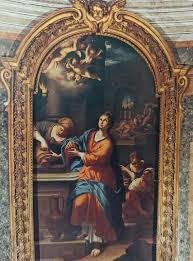
Le tableau rappelle ce que les Leggendari romains, récits légendaires composés entre le Ve et le VIe siècle et très diffusés au Moyen Âge, rapportent sur la vie et les œuvres de la martyre.
Le sénateur romain Pudent, père de Praxède et de Pudentienne, fut parmi les premiers membres de la haute société à se convertir au christianisme, suivi par ses filles. Pudent possédait une villa, dont les vestiges se trouvent à neuf mètres sous l’actuelle basilique et dont les quatre colonnes de porphyre rouge du ciborium sont le témoignage, où il cachait les chrétiens persécutés.
Après que Pudent eut subi le martyre, Praxède et Pudentienne firent construire, avec le consentement du pape Pie Ier, un baptistère dans l’église fondée par leur père. Pudentienne subit elle aussi le martyre durant les persécutions d’Antonin le Pieux, qui se poursuivirent tout au long du règne de l’empereur de 138 à 161 apr. J.-C. ; il ne s’agissait pas de persécutions systématiques, mais de condamnations à mort fondées principalement sur des dénonciations individuelles et sur le fanatisme, et non sur un édit général de l’empereur.
À la mort de sa sœur, Praxède utilisa le patrimoine familial pour faire construire une église “sub titulo praxedis”, comme le rapporte une plaque plus tardive datée de 491 apr. J-C. La jeune femme cacha de nombreux chrétiens persécutés et recueillit les corps des martyrs pour les ensevelir dans le cimetière de Priscilla, sur la Via Salaria, où elle-même trouva sépulture après son martyre, aux côtés de sa sœur et de son père.
Certains récits hagiographiques racontent que Praxède et Pudentienne donnaient sépulture aux martyrs dans les puits situés au sein des vastes propriétés de leur père, tandis que d’autres rapportent que la jeune femme recueillait le sang des martyrisés en le versant dans un puits. Cependant, ces deux actions paraissent improbables : la première parce que la décomposition des corps aurait infesté l’eau des puits et les campagnes environnantes, provoquant une odeur insupportable et de vastes épidémies ; la seconde parce que recueillir le sang des morts était, à l’époque, une pratique tout à fait inhabituelle.
L’église actuelle est le fruit du remaniement de 817 par le pape Paschal Ier, qui fit construire un nouvel édifice sacré à la place du précédent pour recueillir les ossements de 2300 martyrs enterrés notamment dans le cimetière de Priscille. Le 20 janvier 817 le pape les fit transférer à l’intérieur de la ville pour les distribuer dans diverses églises ; à Santa Prassede ils furent déposés dans la crypte sous le maître-autel, où furent également transférées de très nombreuses reliques provenant des catacombes de Saint-Alexandre sur la Via Nomentana.
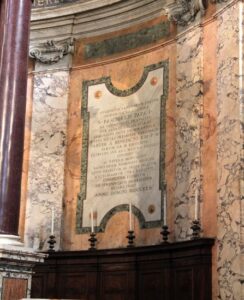
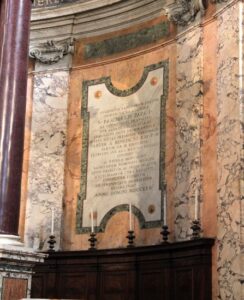
Après une vie consacrée à l’Église, le Cardinal Ludovico Pico mourut à Rome le 10 août 1743, dans son palais situé près de la basilique des Santi XII Apostoli, où se tinrent ses funérailles. Sa dépouille fut ensuite transférée dans la nouvelle église du Santissimo Nome di Maria près de la colonne Trajane, également à Rome, dont il été un généreux bienfaiteur et dont il avait promu la construction en 1738, et où il fut enterré selon sa volonté. Dans l’église, près du maître-autel, se trouve une plaque commémorative qui rappelle l’illustre Cardinal. Par ailleurs, à Santa Prassede le Cardinal Angelo Maria Querini, érudit, collectionneur et Cardinal Titulaire de la basilique, composa et lut un éloge funèbre en l’honneur de son grand prédécesseur. Toujours à Santa Prassede, pour laquelle le cardinal Pico avait fait preuve de tant d’engagement et de dévotion, une plaque de marbre située à côté du presbytère et datée de 1730 rappelle son œuvre méritoire.
Pour souligner sa foi et sa dévotion envers l’Église, le Cardinal Pico laissa dans son testament un legs pour trois cents messes, deux cents à célébrer dans les églises de Rome et cent dans le diocèse d’Albano, dont il avait été Cardinal-Évêque.
Traduit par l’auteure
Bibliographie :
- G. Paviolo, I testamenti dei cardinali: Ludovico Pico della Mirandola (1668-1743), Lulu, 2019 S. Tabacchi, Pico Ludovico, in Dizionario Biografico degli italiani, in Enc. Treccani, vol.83, 2015
- Ceretti, Biografie pichensi, III, Mirandola, 1911
Ludovico Pico della Mirandola, in www.cathopedia.org;
Pico della Mirandola Ludovico, in www.performart.huma-num.fr
- Ballardini, M. Caperna, A Santa Prassede nella Gerusalemme nuova, in Convivium, Univ. Masaryk, Brno, 2020
- Caperna, La basilica di Santa Prassede: il significato della vicenda architettonica, Quasar, Roma, 2014
- Gallio, La basilica di Santa Prassede, Ed. Marconi, Genova, 2000
- Rendina, Le chiese di Roma, Newton Compton, Roma, 2000
Storia della Roma papale. Basilica di Santa Prassede, in www.borgato.be
C.G. Coda (a cura di), Duemilatrecento corpi di martire: la relazione di Benigno Aloisi (1729) e il ritrovamento delle reliquie nella basilica di S. Prassede in Roma, Roma, 2004
- Federici, La notitia martyrum di S. Prassede, in Bollettino storico italiano per il Medio Evo, 1949 H. Delehaye, Les légendes hagiographiques, Bruxelles, Société des Bollandistes, 1905
- Delehaye, Étude sur le Légendier romain : les saints de novembre et de décembre, Bruxelles, Société des Bollandistes, 1936
Santa Prassede di Roma, martire in www.santiebeati.it
Born in Mirandola, she holds multiple Master’s Degrees from the Alma Mater Studiorum, University of Bologna, having developed a distinguished multidisciplinary profile in philosophy, literature, history and the arts. She founded her own Studio Didattico, a private teaching school, where she taught for over twenty years as a private tutor and learning coordinator. Alongside this activity, she spent fifteen years teaching humanities in public secondary schools in the province of Modena. Over the years, she has also supplemented her studies with specialisation courses at prestigious Italian foundations.
A former editor of art texts and author of handbooks on various specialised topics, she has conducted seminars and lecturers also abroad in Italian art.
She maintains ongoing professional collaborations in various capacities with university professors in Italy and abroad.
She is an independent researcher, writer and ghostwriter.
Her collaboration with Al Barnardon is driven by the conviction that local culture in all its facets, from art to history, literature to philosophy, and traditions, represents an invaluable heritage to be supported and enhanced.
CARDINAL PICO DELLA MIRANDOLA: THE SHADOW OF THE PAPACY AND THE LIGHT OF RELICS
Ludovico Pico was born in 1668, the last male child of the Duke of Mirandola Alessandro II and Anna Beatrice d’Este. He spent his youth in Mirandola where he was tutored in his studies first by the Somascan father Leonardo Bonetti and later by Fulvio Tangerini, a friar, theologian and court diplomat. After earning his doctorate in utroque iure, a title conferred upon graduates in both Civil and Canon Law, he was destined for a religious life as early as 1683. Following his father’s death in 1691, he became involved in the difficult situation of the Duchy, which passed to his nephew Francesco Maria, son of his deceased brother Francesco, under the guardianship of his aunt Brigida.
In 1693 he was forced to leave Mirandola following the accusations made by Brigida, who charged him and his brothers Galeotto and Giovanni with the attempted poisoning of Francesco Maria.
He was consequently forced into exile, moving first to Bologna, then to Vienna at the court of Emperor Leopold I of Habsburg, where he went on the advice of Cardinal Rinaldo d’Este. Although the Imperial Court, to which he had appealed, cleared him and his brothers of the poisoning charges, he was ordered not to return to Mirandola to avoid disrupting the fragile political balance that had been achieved.
He then moved to Rome, where he began his brilliant ecclesiastical career holding numerous prestigious positions: in 1706 he was appointed Chamberlain to Clement XI, Patriarch of Constantinople and Assistant to the Pontifical Throne; in 1707 he was Prefect of the Apostolic Palace and Governor of the Palace of Castel Gandolfo; in 1712 he was created Cardinal and in 1717 Chamberlain of the College of Cardinals and Archbishop of Senigallia; in 1724 he became Prefect of the Congregation for Indulgences and Sacred Relics; in 1728 he was named Cardinal-Priest of Santa Prassede, followed by two further ordinations in 1731 as Cardinal-Bishop of Albano and in 1740 of Porto and Santa Rufina.
However, the highlight of his ecclesiastical career was his participation in four conclaves, in 1721, 1724, 1730 and 1740. While his name was briefly considered among the possible candidates in the 1721 conclave, it was in 1730 that Cardinal Annibale Albani formally proposed Pico’s candidacy, but he was not elected due to the opposition of the emperor, who succeeded in mobilising 25 Cardinals against him, a manoeuvre that prompted Pico to withdraw his candidacy. In the conclave of 1740, Cardinal Pico again emerged as a potential compromise candidate between the Albani and Corsini factions. Although ultimately unsuccessful, he remained a figure of great prominence and power within the 18th-century Roman Curia.
In his capacity as a Prince of the Church his artistic and religious patronage was highly successful, particularly in the relocation of ancient relics and the promotion of significant decorative interventions aimed at enhancing the artistic and spiritual heritage of places of worship. The search for relics responded to a requirement of the Roman Church established by the Council of 1725, which mandated that the Titular Cardinals of the Basilicas conduct an official recognition of the relics preserved under the altars with the aim of verifying their authenticity and ensuring their proper preservation.
Ludovico Pico served as the Cardinal-Priest of Santa Prassede from 1728 to 1731, the central period of the research work. Furthermore, from 1724 he held the office of Prefect of the Congregation for Indulgences and Sacred Relics, a title that made him particularly qualified for this type of investigation. His most significant achievement as Cardinal of the Basilica di Santa Prassede was the discovery of the relics of the titular Saint and of Saint Pudentiana, the reason why his image has been immortalised within this historic building. In addition to the Saints’ relics, Pico also rediscovered the tomb of Pope Paschal I. In fact, upon the Pope’s death in 824, the Roman people, due to political tensions, denied him burial in San Pietro, consequently, his successor, Pope Eugene II, had him buried in Santa Prassede.
The Cardinal ordered excavations beneath the high altar, erected by Pope Paschal I in the 9th century, with the intention of finding the original burials of Saint Praxedes, her sister Pudentiana and other Martyrs. The excavations, which took place between 1728 and 1734, brought to light two precious ancient sarcophagi, marked with the names of Saint Praxedes and Saint Pudentiana, thus confirming that the remains of the two Saints had been identified.
To provide a worthy setting for the relics Pico entrusted the reorganisation of the presbytery and crypt to the architect Francesco Ferrari. Active in Rome during the first half of the 18th century and a member of the Accademia di San Luca, Ferrari was highly successful in restoring ancient Roman churches, following the guidelines of a more cautious papal building policy after the splendour of the 17th century.
The works, commissioned and constantly overseen by Cardinal Pico, involved the renovation of the presbytery and the crypt.
The presbytery area was modified with the construction of a balustrade and the addition of stairs leading to the altar. In the 1798, during the occupation of Rome by Napoleonic troops, the steps made of magnificent rosso antico marble were nearly dismantled and transported to France by order of Napoleon, who desired the marbles for his imperial throne.
In addition to the two lateral flights of stairs ascending towards the altar, a descending one was built leading to the crypt, where the sarcophagi containing the holy relics were found. Thus, a central access to the crypt was created in the form of a small oblique corridor, situated where there had previously been a storage chamber for the many relics moved from the Catacombe di Priscilla by Pope Paschal I, including those of Praxedes, Pudentiana and their father Pudens.
The corridor ends with a small altar embellished by a Cosmatesque marble antependium with geometric and polychrome decorations. Above the altar is an 18th-century fresco, a recreation of the one that existed in the ancient relic chamber which had been destroyed.
Cardinal Pico had four strigilated tub-shaped sarcophagi placed on the sides of the corridor, stacked two by two and separated by marble bands. On the lower right is the sarcophagus containing the relics of Saint Praxedes, while the others house the remains of Saint Pudentiana, the Martyrs and the Pope Paschal I.
Above the marble containers are placed two cartouches, in Latin and Italian, which report how “the ashes and precious bones” of the holy Martyrs translated by Pope Paschal I were “by Cardinal Ludov. Pico della Mirandola…rediscovered in the year 1729 and duly sealed, were religiously replaced in these urns in the year of the Christian era 1735”.
The head of Praxedes, however, is located in the papal altar of the Sancta Sanctorum in the Pontifical Sanctuary of the Scala Santa in Rome. The precious Byzantine silver reliquary containing it was exhibited at the Vatican Library Museum from 1905 to 1907. Part of the relics of Saint Pudentiana was also translated in 1803 beneath the high altar of the Basilica that bears her name.
At the back of the crypt, a black marble slab was placed; according to legend, this was the stone on which Praxedes slept to mortify her flesh and which was used to seal her tomb. On either side are two frescoes depicting the Saint’s parents, Pudens and Savinilla (or Sabina).
The renovation commissioned by Cardinal Pico served a dual purpose: to authenticate and enhance the value of the rediscovered relics, exhibited in the crypt ever since, and to modernise the presbytery, giving it a more harmonious appearance consistent with the late Baroque style of the period.
For the occasion, a commemorative painting entitled “Saint Praxedes collecting the blood of the Martyrs” (1735) was also commissioned from Domenico Maria Muratori; by celebrating the Saint’s act of piety, it became the visual centrepiece of the presbytery renovated by Pico.
The painting recalls what the Roman Leggendari, accounts composed between the 5th and 6th century and widely circulated in the Middle Ages, report regarding the life and works of the Martyr.
The Roman senator Pudens, father of Praxedes and Pudentiana, was among the first high-ranking converts to Christianity, followed by the conversion of his daughters.
Pudens owned a villa – the remains of which lie 9 meters below the current Basilica, and to which the four red porphyry columns of the ciborium bear witness – where he used to hide persecuted Christians.
When Pudens suffered martyrdom, Praxedes and Pudentiana, with the consent of Pope Pius I, had a baptistery built in the church founded by their father. Pudentiana also suffered martyrdom during the persecutions of Antoninus Pius, which lasted throughout the emperor’s reign from 138 to 161 A.D. These were not systematic persecutions, but death sentences based primarily on individual denunciations and fanaticism, rather than on a general imperial edict.
Upon her sister’s death, Praxedes used the family estate to build a church “sub titulo praxedis”, as recorded by a later inscription dating to 491 A.D. The young woman hid many persecuted Christians and collected the bodies of the martyred to bury them in the Catacombe di Priscilla on the Via Salaria, where she also found burial alongside her sister and father after her own martyrdom.
Some hagiographic accounts narrate that Praxedes and Pudentiana buried the Martyrs in wells located within their father’s vast estates, while others report that the young woman collected the blood of the martyred, later emptying it into a well. Both actions, however, seem improbable: the first because decomposing bodies would have contaminated the well water and the surrounding countryside, causing an unbearable stench and widespread epidemics, and the second because collecting the blood of the deceased was completely unusual at that time.
The current church is the result of the reconstruction by Pope Paschal I in 817, who built a new sacred edifice in the place of the previous one to house the bones of 2300 Martyrs. These remains, primarily buried in the Catacombe di Priscilla, were brought inside the city by the Pope on January 20, 817, and distributed among various churches. At Santa Prassede, they were placed in the crypt beneath the high altar, where numerous relics from the Catacombe di Sant’ Alessandro on the Via Nomentana were also translated.
After a life dedicated to the Church, Cardinal Ludovico Pico died in Rome on August 10, 1743, in his palace near the Basilica dei Santi XII Apostoli, where his funeral was held. His body was then transferred to the new church of SS. Nome di Maria at Trajan’s Column, also in Rome. He had been a generous benefactor of this church, promoting its construction in 1738, and was buried there according to his wishes. A plaque near the high altar commemorates the illustrious Cardinal. In Santa Prassede, however, Cardinal Angelo Maria Querini, an erudite, collector and the Cardinal Titular of the Basilica, composed and read a funeral eulogy in honour of his great predecessor. Furthermore, in Santa Prassede, for which Cardinal Pico had shown such commitment and devotion, a marble tablet dated 1730 stands at the side of the presbytery, commemorating his meritorious work.
As a testament to his faith and devotion to the Church, Cardinal Pico left a legacy in his will for 300 Masses, 200 in the churches of Rome and 100 in the diocese of Albano where he had served as Cardinal Bishop.
Translated by the author
Bibliography:
- G. Paviolo, I testamenti dei cardinali: Ludovico Pico della Mirandola (1668-1743), Lulu, 2019 S. Tabacchi, Pico Ludovico, in Dizionario Biografico degli italiani, in Enc. Treccani, vol.83, 2015
- Ceretti, Biografie pichensi, III, Mirandola, 1911
Ludovico Pico della Mirandola, in www.cathopedia.org
Pico della Mirandola Ludovico, in www.performart.huma-num.fr
- Ballardini, M. Caperna, A Santa Prassede nella Gerusalemme nuova, in Convivium, Univ. Masaryk, Brno, 2020
- Caperna, La basilica di Santa Prassede: il significato della vicenda architettonica, Quasar, Roma, 2014
- Gallio, La basilica di Santa Prassede, Ed. Marconi, Genova, 2000
- Rendina, Le chiese di Roma, Newton Compton, Roma, 2000
Storia della Roma papale. Basilica di Santa Prassede, in www.borgato.be
C.G. Coda (a cura di), Duemilatrecento corpi di martire: la relazione di Benigno Aloisi (1729) e il ritrovamento delle reliquie nella basilica di S. Prassede in Roma, Roma, 2004
- Federici, La notitia martyrum di S. Prassede, in Bollettino storico italiano per il Medio Evo, 1949 H. Delehaye, Les légendes hagiographiques, Bruxelles, Société des Bollandistes, 1905
- Delehaye, Étude sur le Légendier romain: les saints de novembre et de décembre, Bruxelles, Société des Bollandistes, 1936
Santa Prassede di Roma, martire in www.santiebeati.it
Nata a Mirandola, è plurilaureata e ha conseguito le proprie lauree presso l’Alma Mater Studiorum-Università di Bologna, sviluppando un profilo multidisciplinare d’eccellenza negli ambiti filosofico, letterario, storico e artistico.
Ha fondato e insegnato per oltre vent’anni nel proprio Studio Didattico, una private teaching school, operando come private tutor and learning coordinator. A questa attività ha affiancato quindici anni di docenza di materie umanistiche nelle scuole secondarie statali della provincia di Modena. Nel corso degli anni ha inoltre integrato i propri studi con percorsi di specializzazione presso prestigiose fondazioni italiane.
Già redattrice di testi d’arte e autrice di dispense su vari argomenti specialistici, ha tenuto seminari e conferenze anche all’estero sull’arte italiana.
Collabora stabilmente a vario titolo con docenti universitari in Italia e all’estero.
È ricercatrice indipendente, scrittrice e ghostwriter.
Ha intrapreso la collaborazione con Al Barnardon mossa dalla convinzione che la cultura locale in ogni sua sfaccettatura -dall’arte alla storia, dalla letteratura alla filosofia e alle tradizioni- rappresenti un patrimonio inestimabile da sostenere e valorizzare.
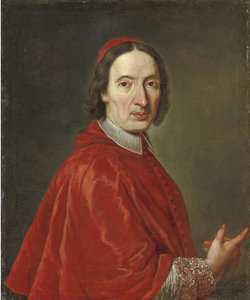
Ludovico Pico nacque nel 1668, ultimo figlio maschio del duca della Mirandola Alessandro II e Anna Beatrice d’Este.
Passò la giovinezza a Mirandola seguito negli studi dal padre somasco Leonardo Bonetti e in seguito da Fulvio Tangerini, frate, teologo e diplomatico di corte. Dopo il dottorato in utroque iure titolo conferito ai laureati sia in diritto civile che canonico, fu destinato alla vita religiosa già dal 1683. Dopo la morte del padre nel 1691 venne coinvolto nella difficile situazione del ducato che passò al nipote Francesco Maria, figlio del defunto fratello Francesco e posto sotto la tutela della zia Brigida.
Nel 1693 fu costretto ad abbandonare Mirandola in seguito alle accuse di Brigida che imputava a lui e ai suoi fratelli Galeotto e Giovanni il tentato avvelenamento di Francesco Maria.
È dunque costretto all’esilio prima a Bologna, poi a Vienna presso l’imperatore Leopoldo I d’Asburgo dove si reca su consiglio del cardinale Rinaldo d’Este. Il tribunale imperiale a cui aveva fatto appello scagionò lui e i fratelli dall’accusa di avvelenamento, ma gli venne imposto di non tornare a Mirandola per non turbare i fragili equilibri politici raggiunti.
Si trasferì quindi a Roma dove iniziò la sua fulgida carriera ecclesiastica ricoprendo numerose e prestigiose cariche: nel 1706 è maestro di camera di Clemente XI, patriarca di Costantinopoli e assistente al soglio pontificio; nel 1707 è prefetto del palazzo apostolico e governatore del palazzo di Castel Gandolfo; nel 1712 è nominato cardinale e nel 1717 camerlengo del Collegio dei Cardinali e arcivescovo di Senigallia; nel 1724 è prefetto della Congregazione per le Indulgenze e le Sacre Reliquie; nel 1728 è cardinale presbitero di Santa Prassede, quindi seguirono altre due ordinazioni nel 1731 a cardinale vescovo di Albano e nel 1740 di Porto e Santa Rufina.
Tuttavia, a spiccare nella sua carriera ecclesiastica fu la partecipazione a ben quattro conclavi, nel 1721, 1724, 1730 e 1740. Se nel conclave del 1721 circolò brevemente il suo nome tra i possibili papabili, in quello del 1730 il cardinale Annibale Albani avanzò la candidatura di Pico, che non venne eletto a causa dell’opposizione dell’imperatore, che riuscì a mobilitargli “contro” 25 cardinali, “manovra” che spinse Pico a rinunciare alla candidatura. Anche nel conclave del 1740 il card. Pico emerse come possibile candidato di compromesso fra le fazioni degli Albani e dei Corsini, purtroppo senza successo, ma rappresentando sempre una figura di rilievo e potere all’interno della Curia romana del XVIII secolo.
In qualità di principe della Chiesa grande successo ebbe la sua attività di patronato artistico religioso, in particolare nella ricollocazione delle antiche reliquie e nella promozione di importanti interventi decorativi che valorizzarono il patrimonio d’arte e spirituale dei luoghi di culto.
La ricerca delle reliquie rispondeva ad un’esigenza della Chiesa romana, stabilita dal Concilio del 1725, che impose ai cardinali titolari delle basiliche la ricognizione ufficiale delle reliquie conservate sotto gli altari con l’obiettivo di verificarne l’autenticità e la corretta conservazione.
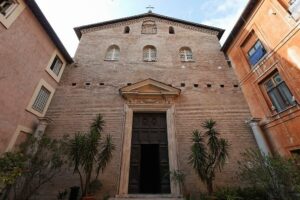
Ludovico Pico fu il cardinale presbitero di Santa Prassede dal 1728 al 1731, periodo centrale dei lavori di ricerca, ed inoltre dal 1724 ricopriva l’incarico di Prefetto della Congregazione per le Indulgenze e le Sacre Reliquie, titolo che lo rendeva particolarmente qualificato per questo tipo di indagini. La sua impresa più importante in qualità di cardinale della basilica di S. Prassede fu il ritrovamento delle reliquie della Santa titolare e di Santa Pudenziana, motivo per cui la sua immagine è stata immortalata in questo storico edificio. Oltre alle reliquie delle sante, Pico ritrovò anche il sepolcro di papa Pasquale I; infatti alla morte del pontefice nell’824 il popolo romano, a causa di tensioni politiche, negò la sua sepoltura in S. Pietro, perciò il successore papa Eugenio II lo fece seppellire in S. Prassede.
Il cardinale ordinò di scavare sotto l’altare maggiore, eretto da papa Pasquale I nel IX secolo, con l’intenzione di ritrovare le sepolture originali di Santa Prassede, della sorella Pudenziana e di altri martiri. Gli scavi, avvenuti tra il 1728 e il 1734, portarono alla luce due preziosi sarcofagi antichi, contrassegnati dai nomi di S. Prassede e S. Pudenziana, confermando dunque che erano state individuate le spoglie delle sante.
Per ospitare degnamente le reliquie Pico affidò i lavori di riorganizzazione dell’area del presbiterio e della cripta all’architetto Francesco Ferrari. Attivo a Roma nella prima metà del XVIII sec. e accademico di San Luca, il Ferrari si cimentava con grande successo nel restauro delle antiche chiese romane, seguendo le indicazioni di una più cauta politica edilizia pontificia dopo i fasti seicenteschi.
I lavori commissionati, e costantemente visionati dal card. Pico, comportarono la ristrutturazione del presbiterio e della cripta.
L’area del presbiterio venne modificata con la costruzione di una balaustra e l’aggiunta di scale che conducono all’altare. I gradini di uno splendido marmo rosso antico nel 1798, durante l’occupazione di Roma delle truppe napoleoniche, rischiarono di essere smontati e trasportati in Francia per volere di Napoleone, che avrebbe desiderato i marmi per il suo trono imperiale.
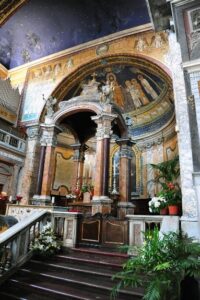
Oltre alle due rampe di scale laterali ascendenti verso l’altare, ne venne costruita una discendente che porta alla cripta, dove furono trovati i sarcofagi con le reliquie delle sante. Fu quindi realizzato un accesso centrale alla cripta dalla forma di un piccolo corridoio obliquo dove prima esisteva una camera di deposito delle molte reliquie spostate dal cimitero di Santa Priscilla da papa Pasquale I, comprese quelle di Prassede, Pudenziana e del padre Pudente.
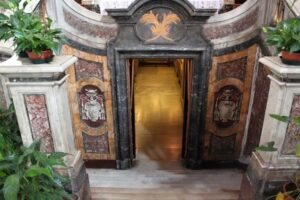
Il corridoio termina con un piccolo altare abbellito da un paliotto marmoreo cosmatesco a decorazioni geometriche e policrome. Al di sopra dell’altare si trova un affresco settecentesco rifacimento di quello esistente nell’antica camera reliquiaria e andato distrutto.
Il card. Pico fece sistemare ai lati del corridoio quattro sarcofagi a vasca strigliata, sovrapposti a due a due e separati da fasce marmore. Sulla destra in basso si trova il sarcofago con le reliquie di Santa Prassede, mentre negli altri sono custoditi i resti di Santa Pudenziana, dei martiri e di papa Pasquale I.
Al di sopra dei contenitori marmorei sono posti due cartigli, in latino e in italiano, che riportano come “le ceneri e le ossa preziose” dei santi martiri traslate da papa Pasquale I furono “dal card. Ludov. Pico della Mirandola…ritrovate nell’a.1729 e debitamente sigillate vennero religiosamente riposte in queste urne l’anno dell’era cristiana 1735”.
Il capo di Prassede invece è collocato nell’altare papale del Sancta Sanctorum nel Pontificio Santuario della Scala Santa a Roma. Il prezioso reliquiario bizantino in argento che lo contiene fu esposto al Museo della Biblioteca vaticana dal 1905 al 1907. Anche una parte delle reliquie di Santa Pudenziana venne poi traslata nel 1803 sotto l’altare maggiore della basilica che porta il suo nome.
Sul fondo della cripta fu inserita una lastra di marmo nero che la leggenda narra essere la pietra sulla quale Prassede dormiva per mortificare il corpo e con la quale fu chiusa la sua tomba. Ai lati si trovano due affreschi raffiguranti i genitori della santa, Pudente e Savinilla (o Sabina).
L’intervento di ristrutturazione voluto dal card. Pico ebbe un duplice scopo: autentificare e valorizzare le reliquie ritrovate e da allora esposte nella cripta e rimodernare il presbiterio conferendogli un aspetto più armonioso e coerente con lo stile tardo-barocco dell’epoca.
Per l’occasione fu commissionato a Domenico Maria Muratori anche un dipinto commemorativo intitolato “Santa Prassede raccoglie il sangue dei martiri” (1735), che celebrando l’atto di pietà della santa divenne il fulcro visivo del presbiterio rinnovato da Pico.
Il dipinto ricorda ciò che i Leggendari romani, racconti composti tra il V e il VI sec. e molto diffusi nel medioevo, riportano della vita e delle opere della martire.
Il senatore romano Pudente, padre di Prassede e Pudenziana, fu tra i primi altolocati convertiti al cristianesimo, a cui seguirono le conversioni delle figlie.
Pudente possedeva una villa, i cui resti si trovano 9 m. sotto l’attuale basilica e di cui le quattro colonne di porfido rosso del ciborio sono testimonianza, nella quale nascondeva i cristiani perseguitati.
Quando Pudente subì il martirio Prassede e Pudenziana con il consenso di papa Pio I fecero costruire un battistero nella chiesa fondata dal padre. Anche Pudenziana subì il martirio durante le persecuzioni di Antonino Pio, che si protrassero per tutto il regno dell’imperatore dal 138 al 161 d.C.; non si trattava di persecuzioni sistematiche, ma di condanne a morte basate soprattutto su denunce individuali e fanatismo e non su un editto generale dell’imperatore.
Alla morte della sorella, Prassede utilizzò il patrimonio di famiglia per costruire una chiesa “sub titulo praxedis”, come riportato da una lapide posteriore del 491 d.C.. La giovane nascose molti cristiani perseguitati e raccolse i corpi dei martirizzati per seppellirli nel cimitero di Priscilla sulla via Salaria dove anche lei, dopo il martirio, trovò sepoltura con la sorella e il padre.
Alcuni racconti agiografici narrano che Prassede e Pudenziana davano sepoltura ai martiri nei pozzi situati nelle vaste proprietà del padre, mentre altri riportano che la giovane raccoglieva il sangue dei martirizzati vuotandolo poi in un pozzo. Entrambe le azioni paiono però improbabili: la prima perché i corpi in decomposizione avrebbero infestato le acque dei pozzi e le campagne circostanti provocando un tanfo insopportabile ed estese epidemie e la seconda perché raccogliere il sangue dei morti era all’epoca impresa del tutto inconsueta.
La chiesa attuale si deve al rifacimento di papa Pasquale I nell’817, che costruì un nuovo edificio sacro al posto del precedente per accogliere le ossa di 2300 martiri, sepolti in particolare nel cimitero di Priscilla, che il 20 gennaio 817 il papa fece portare all’interno della città distribuendole in varie chiese. A Santa Prassede vennero deposte nella cripta sotto l’altare maggiore, dove furono traslate anche moltissime reliquie provenienti dalle catacombe di S. Alessandro sulla via Nomentana.
Dopo una vita dedicata alla Chiesa, il card. Ludovico Pico morì a Roma il 10 agosto del 1743 nel suo palazzo nei pressi della basilica dei Santi XII apostoli, dove si tennero i funerali. La salma venne poi trasferita nella nuova chiesa del SS. Nome di Maria alla Colonna Traiana sempre a Roma, della quale era stato un copioso benefattore e di cui nel 1738 aveva promosso la costruzione, e ivi sepolto secondo la sua volontà. Nella chiesa nei pressi dell’altare maggiore si trova una placca che ricorda l’illustre cardinale. Invece in S. Prassede il card. Angelo Maria Querini, erudito, collezionista e cardinale titolare della basilica, compose e lesse un elogio funebre in onore del suo grande predecessore. Sempre in S. Prassede, per la quale il card. Pico aveva proferito tanto impegno e devozione, è presente una lapide marmorea a lato del presbiterio datata 1730 che ne ricorda il meritorio operato.
A rimarcare la sua fede e devozione alla Chiesa nel testamento il card. Pico lasciò un legato per 300 messe, 200 nelle chiese di Roma e 100 nella diocesi di Albano di cui era stato cardinale vescovo.
Bibliografia di base:
1) M. G. Paviolo, I testamenti dei cardinali: Ludovico Pico della Mirandola (1668-1743), Lulu, 2019; S. Tabacchi, Pico Ludovico, in Dizionario Biografico degli italiani, in Enc. Treccani, vol.83, 2015;
- Ceretti, Biografie pichensi, III, Mirandola, 1911; Ludovico Pico della Mirandola, in www.cathopedia.org; Pico della Mirandola Ludovico, in www.performart.huma-num.fr;
2) A. Ballardini, M. Caperna, A Santa Prassede nella Gerusalemme nuova, in Convivium, Univ. Masaryk, Brno, 2020; M. Caperna, La basilica di Santa Prassede: il significato della vicenda architettonica, Quasar, Roma, 2014; P. Gallio, La basilica di Santa Prassede, Ed. Marconi, Genova, 2000; C. Rendina, Le chiese di Roma, Newton Compton, Roma, 2000; Storia della Roma papale. Basilica di Santa Prassede, in www.borgato.be;
3) C.G. Coda (a cura di), Duemilatrecento corpi di martire: la relazione di Benigno Aloisi (1729) e il ritrovamento delle reliquie nella basilica di S. Prassede in Roma, Roma, 2004; V. Federici, La notitia martyrum di S. Prassede, in Bollettino storico italiano per il Medio Evo, 1949; H. Delehaye, Les légendes hagiographiques, 1905; Santa Prassede di Roma, martire in www.santiebeati.it ;