Roberta Paltrinieri – Perle di cultura – The false Pico and the probable Riario: one face, two identities in the portrait at the Accademia Carrara in Bergamo

The false Pico and the probable Riario: one face, two identities in the portrait at the Accademia Carrara in Bergamo
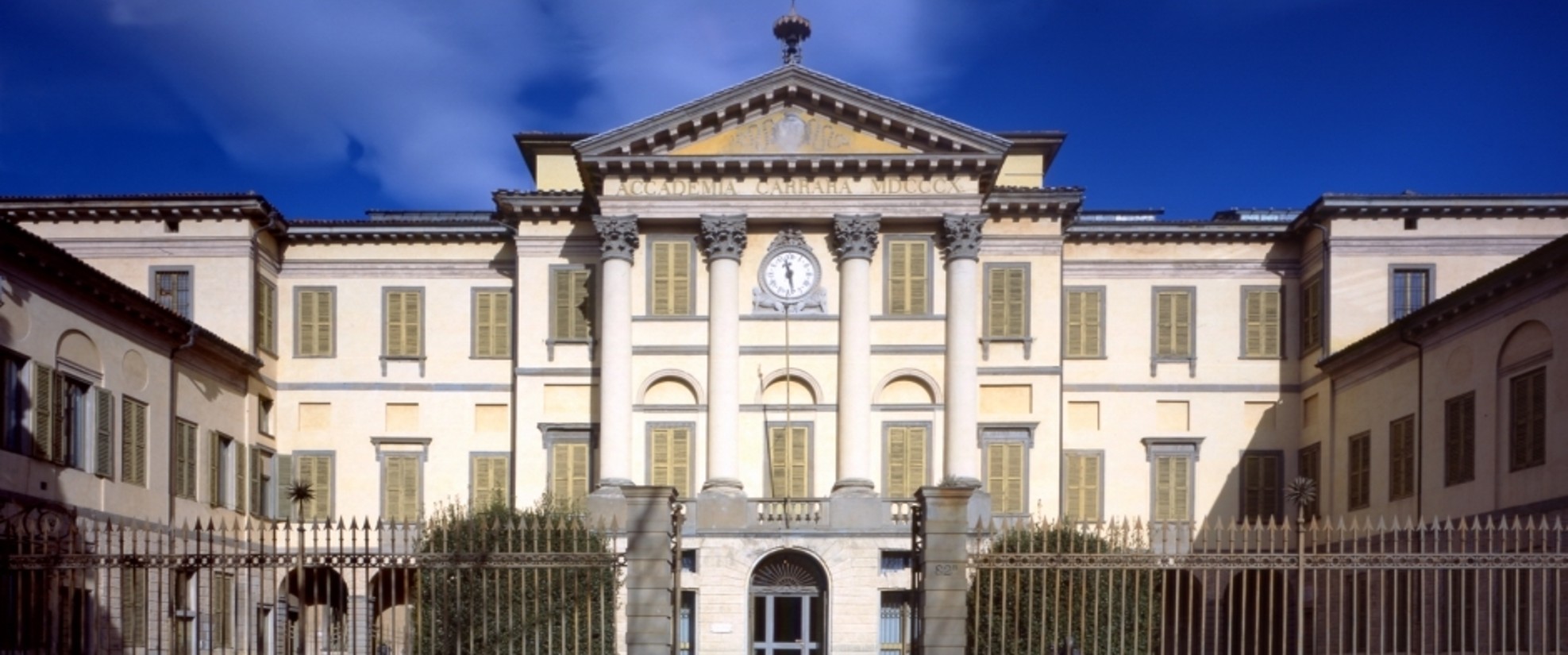
The iconography of Giovanni Pico della Mirandola (1463–1494) constitutes a complex chapter, not without ambiguities, within the study of Renaissance art history. Towards the end of the nineteenth century and for much of the twentieth, art history textbooks, biographical dictionaries and popular essays drew extensively on a visual repertoire lacking rigorous documentary and philological validation. A case in point, in this context, is the oil-on-panel portrait housed at the Accademia Carrara in Bergamo (opening photo), which was long erroneously identified and catalogued by art historians and collectors as the effigy of the philosopher from Mirandola.
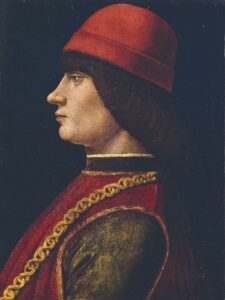
The painting from Bergamo, depicting a young man in half-length portrait, with a distinguished profile and a pensive gaze, characterised by attire of striking Renaissance elegance – a dark gown, a doublet, a red cap, and a very fine gold necklace around his neck – was associated for almost a century with the name of Giovanni Pico. This iconographic association was not rooted in direct documentary evidence, such as contemporary inventories, autograph inscriptions on the reverse of the panel or archival correspondence, but rather in a phenomenon that was widespread in the collecting and antiquarian market between the eighteenth and nineteenth centuries.
During this period, the tendency to attribute anonymous portraits to famous historical or intellectual figures was driven by specific dynamics of heritage and symbolic valorisation. The identification of the figure as Pico della Mirandola – supported by the suggestion of the youthful profile and an aura of classical idealisation – was consequently adsorbed by period museum catalogues and uncritically perpetuated by twentieth-century art historiography.
In the past, preceding the modern critical re-evaluation prompted by the seminal philological contributions of Federico Zeri and Francesco Rossi, the Bergamo panel had been attributed to an anonymous master or linked to illustrious names and general geographical contexts, with opinions wavering between an attribution to Vincenzo Foppa and references to masters from the Lombard-Milanese or Ferrarese schools.
Zeri dismantled the centuries-old identification with Pico della Mirandola by adopting a two-pronged approach – stylistic-critical and physiognomic – based on historical and iconographical evidence.
Through comparative analysis, the art historian first identified physical inconsistencies with the typological models documented as attributable to the philosopher; in fact, the features of the young man in Bergamo work bear no resemblance to the historically verified portraits of the thinker from Mirandola, such as the profiles on fifteenth-century medals or Cosimo Rosselli’s fresco in the Church of Sant’Ambrogio in Florence (The Miracle of the Sacrament, 1486), where Pico is clearly depicted among those present.
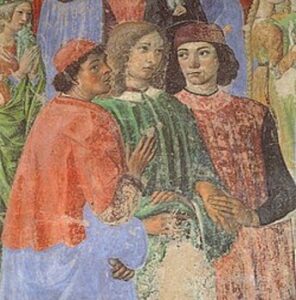
The most recent studies have therefore attributed the painting to the field of court portraiture and the hypothesized identity of the subject as a member of the noble Riario family, originally from Savona, specifically Percivalle Riario.
The Riarios attained extraordinary political and ecclesiastical influence in Rome and Romagna during the fifteenth century, chiefly thanks to the nepotism of Pope Sixtus IV (Francesco della Rovere), producing leading figures of the Renaissance such as Girolamo Riario, Lord of Imola and Forlì, the Pope’s nephew and husband of Caterina Sforza, and Cardinal Raffaele Riario.
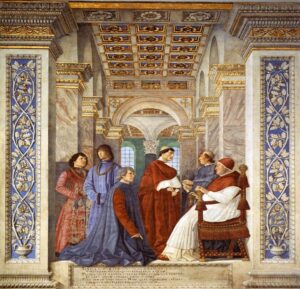
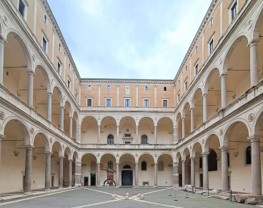
Closely linked to the papal court and a promoter of patronage of the highest calibre – of which the monumental Palazzo della Cancelleria in Rome remains an emblematic testimony – the family enjoyed a position of preeminent cultural and social standing. This would fully account for the aristocratic air and refined figurative elegance of the portrayed young man, elements which, in the centuries that followed, facilitated his evocative overlap with the archetype of the young philosopher from Mirandola.
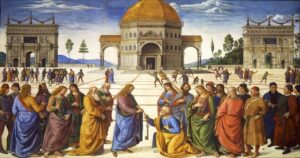
By dating the panel to the Umbrian-Roman school around 1480, Zeri identified a probable physiognomic resemblance between the Bergamo figure and the faces of individuals associated with the papal circle who appear in the Vatican frescoes of the period: in particular, in the famous fresco by Melozzo da Forlì, Sixtus IV appoints Platina as prefect of the Vatican Library, and in Perugino’s Handing Over of the Keys in the Sistine Chapel. It is precisely among the entourage of Sixtus IV and the members of the Riario family, depicted as bystanders on the walls of the Sistine Chapel, that the art critic recognised the young man’s possible features, going so far as to suggest his identification as Percivalle Riario.
In the proposal to attribute the painting to the artist Rocco Zoppo (born Giovanni Maria di Bartolomeo Bacci), put forward by Zeri and Rossi, there is a compelling convergence between formal elements and contextual evidence.
As documented by Giorgio Vasari in his Lives, Rocco Zoppo was in fact one of Perugino’s closest collaborators and a true companion, actively assisting him in the fresco decoration of the Sistine Chapel. In that artistic enterprise, he worked in close contact with the papal entourage and the Riario family, a context that would fluidly and plausibly explain how the painter might have come to execute this private portrait of the nobleman.
The technical execution and formal characteristics of the painting in the Accademia Carrara faithfully reflect the artistic language of the Umbrian-Roman school of the 1480s, revealing its derivation from Perugino’s sculptural and chiaroscuro models, adapted to the stylistic traits of Zoppo’s workshop.
While, from a deconstructive perspective, the exclusion of any identification with Pico della Mirandola can now be considered definitive and beyond any reasonable doubt, the concurrent identification of the sitter as Percivalle Riario, as well as the proposal to attribute the work to the hand of Rocco Zoppo on the basis of his proximity to the papal milieu, although supported by solid historical and iconographic plausibility, must nevertheless be received with due methodological caution. It is no coincidence that the most recent catalogues (including the General Catalogue of Cultural Heritage) appropriately retain a question mark next to Riario’s name, demonstrating that this is a brilliant and persuasive working hypothesis rather than a fact established with absolute certainty.
In the context of Renaissance portraiture and its subsequent critical reception, particularly between the nineteenth and twentieth centuries, the history of the Bergamo painting stands as a paradigmatic case of iconographic pseudomorphosis. This process is set in motion when a specific formal pattern – the type of young man portrayed in three-quarter view or profile, elegantly dressed and endowed with a noble and expressive countenance – becomes established as a characteristic visual motif of the late fifteenth century.
Upon this specific formal structure, nineteenth-century romantic collecting projected an arbitrary conceptual overlay: the myth of Giovanni Pico della Mirandola, who came to be regarded as the very archetype of the cultured, attractive and refined young philosopher. The visual form of the painting, which the revised attribution would strongly links to the hypothesis that it is a portrait of Percivalle Riario, has thus long been imbued with a fictitious identity of great figurative and cultural impact.
It was only the scientific criticism of the latter half of the twentieth century that carried out the reverse methodological operation, undoing the pseudomorphosis and separating the actual form (the probable image of the young Riario) from the mythical significance that had become unduly layered over time.
The operation carried out by Zeri embodies, in fact, the need to free museum collections from the grandiloquent nineteenth-century labels, often dictated by romantic notions such as the myth of the charming and learned Pico, in order to restore works of art to their true historical and contextual reality.
With the proposed reattribution of the painting in the Accademia Carrara in Bergamo to Rocco Zoppo and the hypothetical identification of its subject as Percivalle Riario, Pico’s iconography loses a false attribution and gains a scientifically impeccable frame of reference.
The removal of the Bergamo painting from the humanist’s figurative corpus thus ensures that his actual figurative works are finally defined with accuracy and consistency.
Translated by the author
BIBLIOGRAPHICAL REFERENCES
- Catalogo Generale dei Beni Culturali, Ritratto maschile (Percivalle Riario?), scheda n C0050-00976_R03; Accademia Carrara, Bergamo;
- Garuti, A., Per un’iconografia pichiana: ritratti reali e d’invenzione di Giovanni Pico della Mirandola, in Giovanni Pico della Mirandola. Convegno internazionale di studi per il V centenario della morte, a cura di G.C. Garfagnini, Firenze, Olschki, 1997;
- Rossi, F., Accademia Carrara, Bergamo. Catalogo dei dipinti, Milano, Electa, 1988;
- Scarpellini, P., Perugino, Milano, Electa, 1984;
- Todini, E., La pittura umbra dal Duecento al Primo Cinquecento, Milano, Longanesi, 1989;
- Vasari, G., Le vite de’ più eccellenti architetti, pittori, et scultori italiani, da Cimabue insino a’ tempi nostri, a cura di L. Bellosi, A. Rossi, Prefazione di G. Previtali, Torino, Einaudi, 1986/2015;
- Zeri, F., Ritratti attribuiti al Perugino e la cerchia di Rocco Zoppo, in Paragone.Arte, n. 347. 1979;
- Zeri, F., Rossi, F., La raccolta Morelli nell’Accademia Carrara, Ed. promossa dal Credito Bergamasco, Silvana Editoriale, 1986;
- Zeri, F., Ritratti bolognesi e umbri del Quattrocento, in Paragone.Arte, 1988.

Born in Mirandola, she holds multiple Master’s Degrees from the Alma Mater Studiorum, University of Bologna, having developed a distinguished multidisciplinary profile in philosophy, literature, history and the arts. She founded her own Studio Didattico, a private teaching school, where she taught for over twenty years as a private tutor and learning coordinator. Alongside this activity, she spent fifteen years teaching humanities in public secondary schools in the province of Modena. Over the years, she has also supplemented her studies with specialisation courses at prestigious Italian foundations.
A former editor of art texts and author of handbooks on various specialised topics, she has conducted seminars and lecturers also abroad in Italian art.
She maintains ongoing professional collaborations in various capacities with university professors in Italy and abroad.
She is an independent researcher, writer and ghostwriter.
Her collaboration with Al Barnardon is driven by the conviction that local culture in all its facets, from art to history, literature to philosophy, and traditions, represents an invaluable heritage to be supported and enhanced.