

Roberta Paltrinieri – Perle di cultura – The monumental ark of Prendiparte Pico in San Francesco a Mirandola – A zoological identification, mule or donkey?


Born in Mirandola, she holds multiple Master’s Degrees from the Alma Mater Studiorum, University of Bologna, having developed a distinguished multidisciplinary profile in philosophy, literature, history and the arts. She founded her own Studio Didattico, a private teaching school, where she taught for over twenty years as a private tutor and learning coordinator. Alongside this activity, she spent fifteen years teaching humanities in public secondary schools in the province of Modena. Over the years, she has also supplemented her studies with specialisation courses at prestigious Italian foundations.
A former editor of art texts and author of handbooks on various specialised topics, she has conducted seminars and lecturers also abroad in Italian art.
She maintains ongoing professional collaborations in various capacities with university professors in Italy and abroad.
She is an independent researcher, writer and ghostwriter.
Her collaboration with Al Barnardon is driven by the conviction that local culture in all its facets, from art to history, literature to philosophy, and traditions, represents an invaluable heritage to be supported and enhanced.
THE MONUMENTAL TOMB OF PRENDIPARTE PICO IN THE CHURCH OF SAN FRANCESCO IN MIRANDOLA: A ZOOLOGICAL IDENTIFICAZION, MULE OR DONKEY?
The church of San Francesco in Mirandola contains an original and enigmatic sculptural element whose complex and elusive interpretation enhances its charm.
The historic church in Mirandola, among the first Franciscan churches in Italy, was likely built shortly after the Saint’s canonisation (1228) around 1286-1287, as evidenced by the will of a certain Matteo Papazzoni who arranged to be buried there during those years. Erected outside the walls, it was originally modest in size, similar to the Porziuncola, with a single nave and a gabled roof. Rebuilt by Costanza of Tommasino Pico, it was reconsecrated in 1400 and incorporated in the northern nucleus of the city following the expansion of the walls in the fifteenth century.

The interior was expanded to three-aisled naves, also highlighted on the large external facade by two pillars, with pointed arches and alternating simple and cruciform columns. A five-arched exterior portico was built in 1660 and later demolished in 1927.

The Pico family, particularly devoted to the Saint of Assisi, elevated the religious building to their Pantheon; in fact, inside the church are located several tombs and funeral memorials of the family members, who were later interred in a common burial vault in the crypt, unfortunately destroyed and filled in around 1922, of the Chapel of the Beata Vergine di Reggio. However, the four monumental hanging tombs, built in more ancient times, remain.
Yet, none of the family members remain interred in the church today. The desecrated, now empty wall tombs were moved several times over the centuries before reaching their current location. The sarcophagus of Prendiparte was even used as the base for the high Altar.
The aligned tombs, fixed to the north wall, belong to Galeotto I (+1499), Prendiparte (+1394), Spinetta (+about1400) and Giovan Francesco I (+1467); the first and the last are Renaissance, while the central two are Gothic, dating to the fifteenth-century reconstruction of the church.
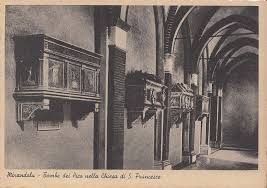
This type of suspended tombs chest, supported by corbels and placed along interior walls of churches, was very widespread in Italy during the fifteenth century. The most artistically and symbolically notable among the Pico family tombs is undoubtedly that of Prendiparte, one of the most significant examples of Gothic sculpture in Emilia and a major achievement of the Dalle Masegne workshop, the celebrated Venetian sculptors. The author of the work was Paolo, son of Jacobello Dalle Masegne, who signed his name, as he did on the tomb of Jacopo Cavalli in Venice, on a small marble slab walled under the tomb which bears an inscription in vernacular: “Quest’opera de talio è fatta in preda – un Venician la fé ch’à nome Polo – nato di Jacomel ch‘à taia preda”, (“This work of cutting is done in stone- a Venetian did it, named Polo- born of Jacomel who is stone cutter”).
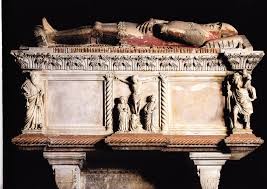
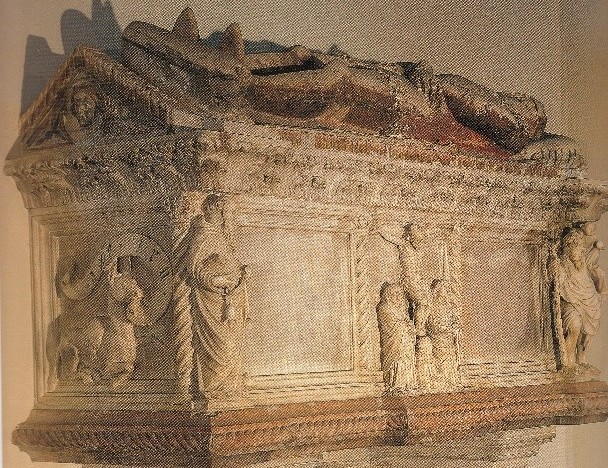
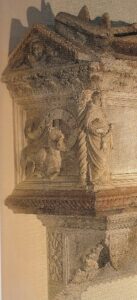
The sarcophagus features a series of reliefs and sculptures of vigorous conception and skilful execution. The life-size statue of the deceased, lying on a ruffled shroud and with his head resting on a tasselled pillow, is positioned on the front of the urn lid, clad in soldier’s armour. Prendiparte was in fact a valiant “condottiero” in the service of the Visconti family and Chief Magistrate (podestà) of Milan, Brescia and Pavia, as well as Lord of Mirandola.
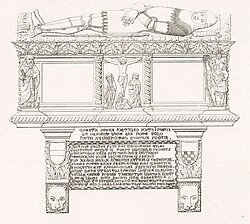
The front of the sarcophagus, divided into three panels, shows a valuable group depicting the Lamentation before the Cross in the central space. In the left corner stands the statue of Saint Anthony the Abbot with a pig at his feet and a bell and a book in his hand, while in the right corner stands the imposing figure of Saint Christopher with the Infant Jesus on his shoulders and a palm branch in his hand.
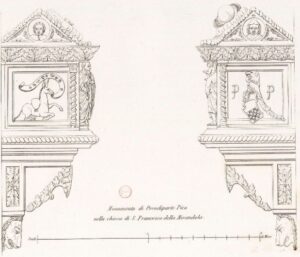
The sides of the sarcophagus are decorated with symbolic motifs: on the right are carved the family crest, the initials of Prendiparte and a dog surmounting a heraldic crest.
However, it is what is depicted on the left side that requires a more careful analysis in order to interpret it correctly. Here, in a combination of low and high relief, we can observe a pack animal prostrate on the ground under the weight of its load, with a fluttering scroll above it bearing an enigmatic inscription, an element that deserves a separate discussion later on.
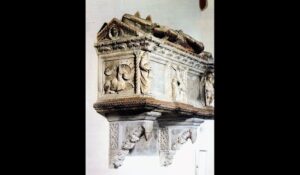
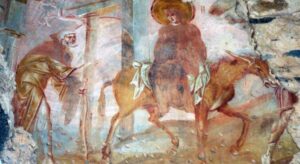
The first question to be answered is what animal it is, that is a zoological identification. Ceretti wrote that it was “a mule fallen to the ground”, a statement later repeated by Cappi. Assuming that it is rather difficult to distinguish whether a relief sculpture depicts a mule or a donkey, it is even more difficult, indeed impossible, to determinate its gender. Given the absence of proven historical sources, the issue must be assessed based on an iconographic and iconological research, that is the comparison with other images, the reference to textual sources and the symbolism. In religious contexts and medieval sacred art the donkey is much more frequently depicted than the mule due to reasons rooted in Holy Scriptures and Christian symbolism. The presence of the donkey was not accidental, but conveyed profound theological messages often at odds with its social perception. This animal was, in fact, a powerful symbol of Christian faith, representing humility and meekness. The most significant role of the donkey, much more central to the biblical narrative than one might imagine, is linked to various episodes in the life of Jesus, also depicted in the great fourteenth century masterpieces by artists such as Giotto, Duccio di Buoninsegna or Pietro Lorenzetti. The apocryphal gospels report that the Virgin Mary, expecting Jesus, was forced to travel to Bethlehem on the back of a donkey, with Joseph by her side, due to the census ordered by the Emperor Augustus.
The donkey is also present in the Nativity: according to the apocryphal gospels it is mentioned alongside the ox as warming the Infant Jesus. While the ox represented the chosen people, the donkey represented the Gentiles, the pagans, and together they signified the union of all peoples before the Messiah.
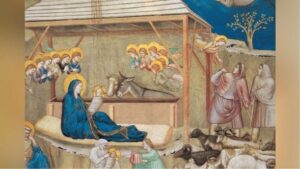
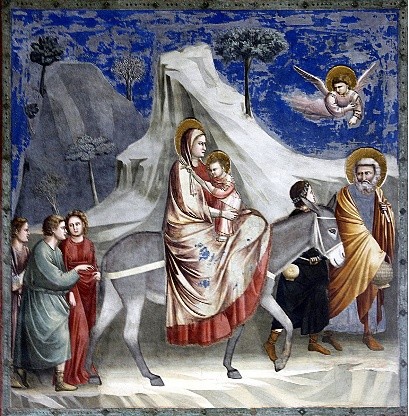
During the flight into Egypt the donkey led the Holy Family to safety from Herod’s tragic wrath, demonstrating service, devotion and humble toil.
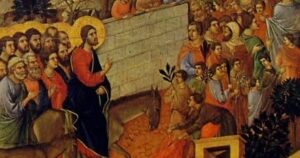
Later during His enter into Jerusalem, on Palm Sunday, Jesus rode a donkey (Matthew 21, 1-7), to fulfil Zachariah’s prophecy (9,9) announcing a Messiah who would arrive in humbly on a donkey, certainly a symbolic choice. In fact, by choosing a beast of burden and peace over a horse, a regal symbol of war and pride, Jesus pointedly emphasized His extreme Humilitas, humility.
Furthermore, in the first representation of the Nativity scene in Greccio in 1223, Saint Francis included the donkey and the ox to make the scene more concrete and touching, in accordance with popular tradition and the apocryphal gospels that identified them as witnesses to the event. The animals also symbolised modesty, poverty and obedience to God’s will, as recalled in Isaiah’s prophecy (1,3) which states: “the ox knows its owner and the donkey its master’s crib”. These words were later interpreted to justify the presence of the ox and donkey in the Nativity scene as symbols of those who recognise the Messiah. In another biblical episode, Balaam’s donkey (Numbers, 22) sees the Angel of God and begins to speak to warn the prophet. The animal recognises God before man himself, thus embodying wisdom and submission to Divine will.
The donkey assumed ambiguous connotations, as frequently documented in medieval bestiaries, only when dissociated from Christ or the Saints. In such secular, popular or sacrilegious contexts the animal could therefore represent negative vices such as ignorance, obstinacy or sloth. Conversely, within sacred art and religious iconography, it exclusively embodied positive virtues including humility, benevolence and spirit of sacrifice.
In the Christian context the mule, highly exploited in daily life because it was stronger and more resilient than the donkey, carried a very negative meaning. Being a sterile hybrid, it was associated with concepts of ingratitude, foolishness, fickleness and guilt. As a sterile hybrid, the mule symbolised impotence and lack of spiritual legacy, making it unfit to represent ideals of salvation and purity. Its infertility, impurity and “fruitlessness” were viewed as negative omens of sin; consequently, the animal was deemed unworthy of appearing in episodes or associations involving the life and mission of Jesus. Furthermore, due to the absence of references in the biblical narrative, it certainly did not enjoy the same iconographic legitimacy as the donkey and it was always considered a controversial and problematic figure in sacred art. It appeared only in specific scenes to covey a negative metaphorical meaning as in the episode of Saint Anthony of Padua’s mule, where it represents infidelity and obstinacy, traits only later converted. In secular art, on the other hand, as an emblem of resistance, strength and sure-footedness, the mule depicted rural life and non-religious travel.
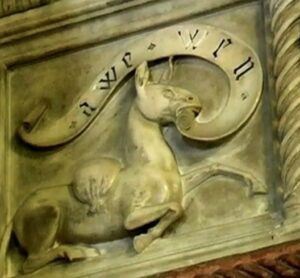
As a funeral monument located in a place of worship the hanging sarcophagus of Prendiparte Pico, a devote believer who died, as his epitaph states, “deeply contrite and confessed”, required images reflecting the sanctity of the site and the deceased’s faith, excluding profane or inappropriate depictions. It is therefore rational to identify the sculpted animal as a donkey, precisely because of the biblical references, iconographic comparisons and the specific context of the church of San Francesco. In fact, the Saint himself insisted on the donkey’s presence in the first Nativity scene, thereby investing the animal with profound religious significance.
Translated by the author
BIBLIOGRAPHY
- Litta, Famiglie celebri d’Italia. Pico della Mirandola, Torino, 1835;
- Ceretti, Indicazioni topografico-storiche su la Mirandola e su cose notevoli d’arte in essa esistenti, Mirandola, 1878;
- Ceretti, Francesco, Prendiparte, Spinetta e Tommasino di Paolo Pico della Mirandola, in Atti e memorie delle R.R. Deputazioni di Storia Patria delle province dell’Emilia, vol. VII, parte II, Modena, 1882, pp.281-334;
- Manni, Arte a Mirandola e nella bassa modenese, Modena, 1988;
- Ferretti, Prendiparte e Spinetta, magnifici miles, in Arte a Mirandola al tempo dei Pico, Mantova, 1994;
- Cappi, La Mirandola-Storia urbanistica di una città, Mirandola, 2000;
- Cappi, Nuovo guida storica ed artistica della Mirandola e dintorni, Ed. Il Dado, 2008;
- Righini, L’armamento tardo trecentesco nelle arche tombali di Prendiparte e Spinetta Pico nella chiesa di S. Francesco a Mirandola, in Ars Historiae. Conoscere e Ricostruire, gen./marzo, 2011;
- D’Ambrosio, Monumento funebre di Jacopo Cavalli, in La Basilica dei Santi Giovanni e Paolo. Pantheon della Serenissima, a cura di G. Pavanello, Marcianum Press, Fondazione Giorgio Cini, 2012;
- Marchesini, S. Tonutti, Il Codice degli Animali magici: simboli, tradizioni e interpretazioni, Milano, De Vecchi, 2019;
- Giusti, I Bestiari medievali, www.accademiafabioscolari.it, 2019
- Vincenti, La percezione dell’asino fra Alto e Basso medioevo, www.fondazioneterradotranto.it, 2025.